Daily acquisition brief // August 27, 2026

CMCoE Meme Intel: August 27, 2026

Four acquisition stories, four real meme templates, and one Rule of Two applied only after the third capable small business.

4 storiesRSS feed
Appropriations law / program reuse

Is this a reprogramming?

GAO found that surplus Hawaii radar hardware could support Guam without turning old Hawaii obligations into a transfer or reprogramming.

Is This a Pigeon meme labeling a surplus radar part moving to Guam and asking whether the hardware move is a reprogramming.
Is this a reprogramming?

What happened

On August 26, GAO issued an appropriations-law decision on Missile Defense Agency funding for Homeland Defense Radar-Hawaii. DOD had obligated fiscal years 2018 through 2022 RDT&E amounts for Hawaii program work, including components, software, engineering, and environmental reviews. After that program's funding stopped, excess components were moved in 2024 for modification in support of Homeland Defense Radar-Guam.

GAO concluded that the Hawaii obligations stayed within the purpose statute and found no evidence that Hawaii funds paid for Guam development or component modifications. Separately designated Guam funds supported the later Guam work, so GAO found no transfer or reprogramming of Hawaii funds.

Why CMCoE cares

Hardware can outlive the program plan that bought it, but property reuse and appropriations use are different questions. Program and contracting teams need records that show what each appropriation actually obligated, when the later work began, and which funding paid for modification rather than assuming the destination of a component tells the fiscal-law story.

Regulatory fine print

GAO did not create a general permission to move funding between programs. Its conclusion depended on evidence that the original Hawaii obligations served the Hawaii program, that no Hawaii funds supported Guam work, that Guam received its own designated funding, and that Congress had directed DOD to leverage existing programs for Guam. Transfer and reprogramming rules still apply when funds, rather than surplus components, move or change purpose.

Sources

  1. GAO - Homeland Defense Radar-Hawaii purpose availability, B-336723 (U.S. Government Accountability Office, )
Contract administration / oversight

Define it or rate it.

DOE field offices evaluated contractor assurance systems without a shared definition or measurable criteria for effectiveness.

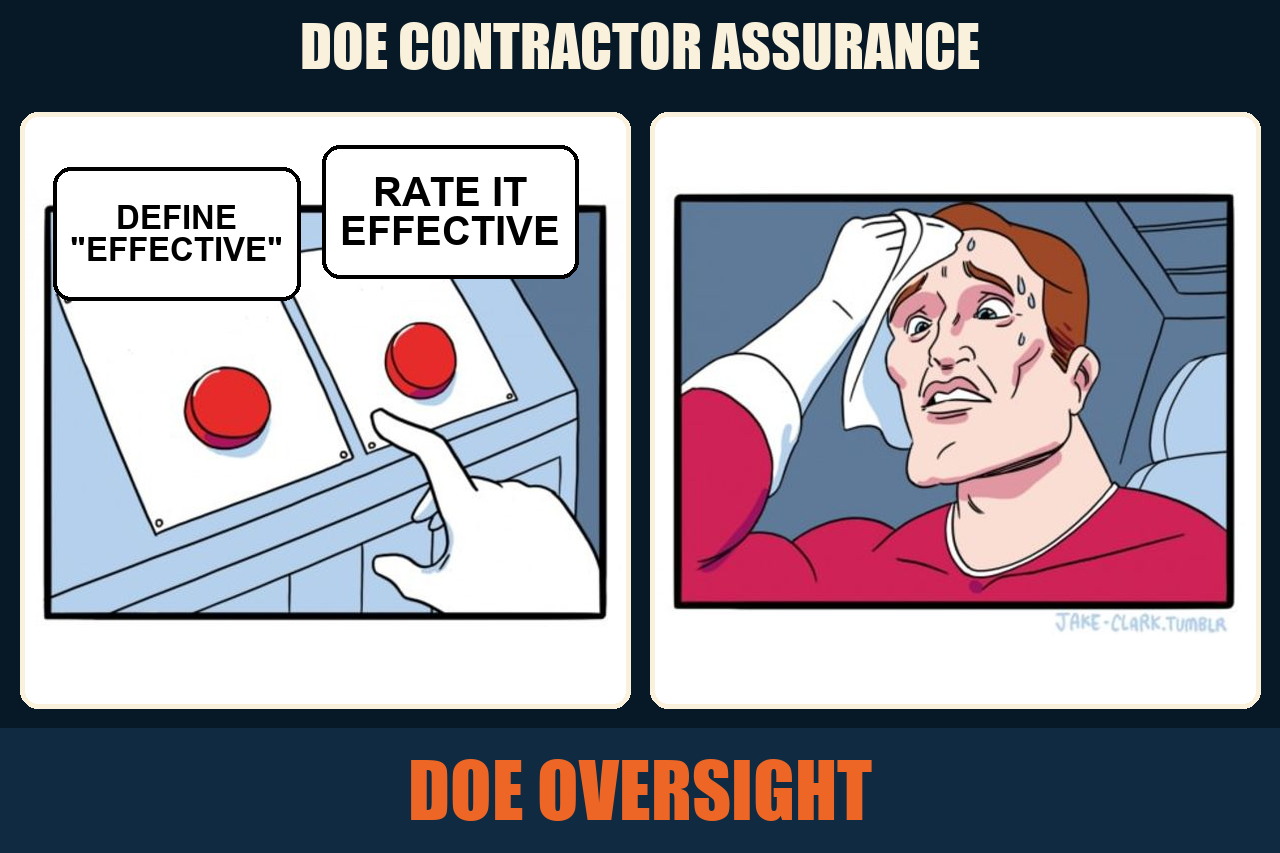
Two Buttons meme showing DOE oversight sweating over Define Effective and Rate It Effective.
Define "effective," or rate it effective?

What happened

GAO released a report on August 26 about contractor assurance systems used in three Department of Energy Office of Environmental Management contracts. Hanford and Idaho field offices called their systems effective, while Los Alamos made no determination, but DOE and EM had not defined effectiveness or established specific evaluation criteria.

GAO also found examples of recurring or poorly managed issues that undercut confidence in those determinations. It made four recommendations, including measurable criteria, risk-informed oversight, and using appropriate contract mechanisms to communicate performance expectations and consequences. DOE concurred.

Why CMCoE cares

Contractor self-assurance can help the government target oversight where risk is highest, but only if the government knows what reliable performance looks like. Acquisition teams should care because undefined standards make surveillance, performance assessments, corrective action, and accountability harder to apply consistently.

Regulatory fine print

GAO reviewed three selected contracts and field offices, not every DOE contract or contractor assurance system. The report did not say contractor self-assurance should replace government oversight, nor did it make a procurement-fraud finding. Its recommendations are open, and DOE's concurrence is not evidence that corrective actions are complete.

Sources

  1. GAO - DOE Contracting: Contractor Assurance Systems (U.S. Government Accountability Office, )

Energy resilience / performance milestones

The Army proposes a trade.

The Army's Janus model puts industry ownership, operation, and milestone performance at the center of installation microreactor delivery.

Trade Offer meme proposing verified Janus milestones in exchange for the next funding increment.
Janus trade offer: verified milestones for the next funding increment.

What happened

On August 26, the Army announced Fort Drum as one of five installations selected for the Janus Program and said Westinghouse Government Services received the associated contract. The planned contractor-owned and operated microreactors would generate less than 20 megawatts, occupy less than five acres, and support critical installation loads.

The Army says vendors will own, construct, and operate the facilities, share development costs, and receive funding against performance-based milestones. The program is funded for five years and targets at least one Army microreactor producing usable electricity by September 30, 2028.

Why CMCoE cares

The business model matters as much as the technology. Contractor ownership and operation can shift some development and operating risk, but it also makes milestone design, acceptance evidence, regulatory interfaces, long-term service obligations, and remedies central acquisition work rather than background administration.

Regulatory fine print

The Army announcement does not disclose the contract value, instrument structure, separate award date, complete milestone terms, or all five contractor-installation pairings. The 2028 date is a program target, not demonstrated performance. Contractor ownership does not remove Army oversight or federal nuclear, environmental, security, and safety requirements.

Sources

  1. U.S. Army - Fort Drum selected for Janus Program microreactor (U.S. Army, )
Bid protest / small business

Find the incapable team.

GAO rejected market research that discounted small-business teams under a self-performance standard the solicitation did not require.

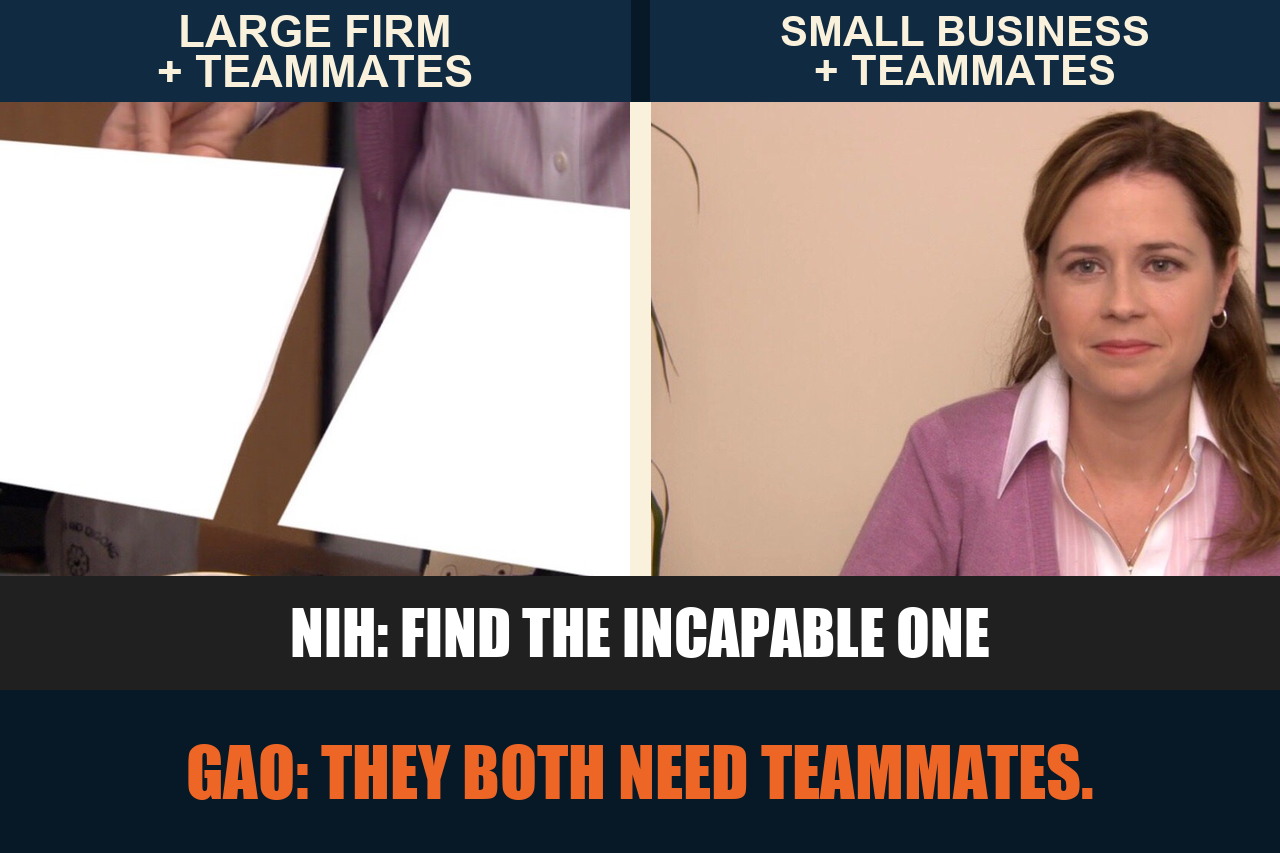
They're the Same Picture meme comparing a large firm with teammates to a small business with teammates and noting that both need teammates.
GAO: They both need teammates.

What happened

GAO publicly posted LJR Solutions on August 24; the decision is dated August 14. It sustained a pre-award protest challenging NIH's decision to compete a scientific and technical services multiple-award IDIQ on a full-and-open basis with a small-business reserve instead of using a total or partial set-aside.

NIH's earlier market research had identified three capable small businesses, but its later record did not meaningfully explain why they were no longer capable. GAO also found it unreasonable to discount small firms for needing subcontractors when no large or small firm was expected to perform the whole volume alone and the solicitation expressly contemplated subcontracting.

Why CMCoE cares

The Rule of Two is not satisfied by saying the requirement is broad and small firms need teammates. Market research must address the actual solicitation, use a consistent capability standard, and document why total and partial set-asides are or are not feasible before an agency relies on a reserve.

Regulatory fine print

GAO did not order NIH to make a total small-business set-aside or hold that every teaming arrangement proves responsibility. It recommended that NIH determine whether a full or partial set-aside is appropriate, including new market research if needed. The decision applied HHS's RFO Part 19 deviation and noted that its Rule of Two requirement is substantively similar to the existing FAR and SBA framework.

Sources

  1. GAO - LJR Solutions, LLC, B-424487 (U.S. Government Accountability Office, )