Daily acquisition brief // August 28, 2026

CMCoE Meme Intel: August 28, 2026

Eight acquisition stories, eight real meme templates, and one mandatory pathway to flexibility.

8 storiesRSS feed
DoD pricing policy / commercial acquisition

The commercial shortcut goes through every ERP.

A DoD pricing directive invokes commercial best practices while seeking actual costs across every supplier tier and exploring direct financial-system APIs.

Left Exit 12 Off Ramp meme showing DoD pricing reform swerving from commercial best practices toward actual costs from every tier, with the caption Reduce burden: add an ERP API.
Reduce burden: add an ERP API.

What happened

An August 18 memorandum from the Deputy Secretary of War reset the department's expectations for supplier cost and pricing information. It directed full transparency throughout all tiers of the supply chain for products and services valued at $10 million or more, regardless of whether the data require certification, and said contracting officers must have actual cost information at prime and supplier levels. Commercially available off-the-shelf items are excepted.

The memorandum said the department will explore application programming interfaces that pull cost information directly from contractor enterprise resource planning or other financial systems to reduce regulatory burden and compliance cost. It also directed submission of thousands of delinquent Cost and Software Data Reporting reports within 30 days. On August 26, Federal News Network reported industry concern that the approach could create new barriers for commercial and lower-tier suppliers.

Why CMCoE cares

The directive reaches price analysis, subcontractor flowdown, commercial-item strategy, financial-system access, cybersecurity, and negotiation leverage. Acquisition teams will need to distinguish the policy objective from the contractual authority and implementation mechanism that would actually obtain data from each tier.

Regulatory fine print

The memorandum is a department policy directive, not a final FAR or DFARS rule and not by itself a new contract clause or system-access right. It directs the acquisition office to explore an automated solution and update underlying issuances and regulations. It exempts COTS items, does not clearly resolve application to existing contracts, and does not establish that the approach is unlawful. The August 26 industry reaction is secondary reporting; the signed memorandum is the underlying source.

Sources

  1. Deputy Secretary memorandum - Supplier Cost and Pricing Transparency (Office of the Deputy Secretary of War, copy hosted by Federal News Network, )
  2. Federal News Network - Industry concerns about DoD acquisition reforms (Federal News Network, )
Bid protest / evaluation consistency

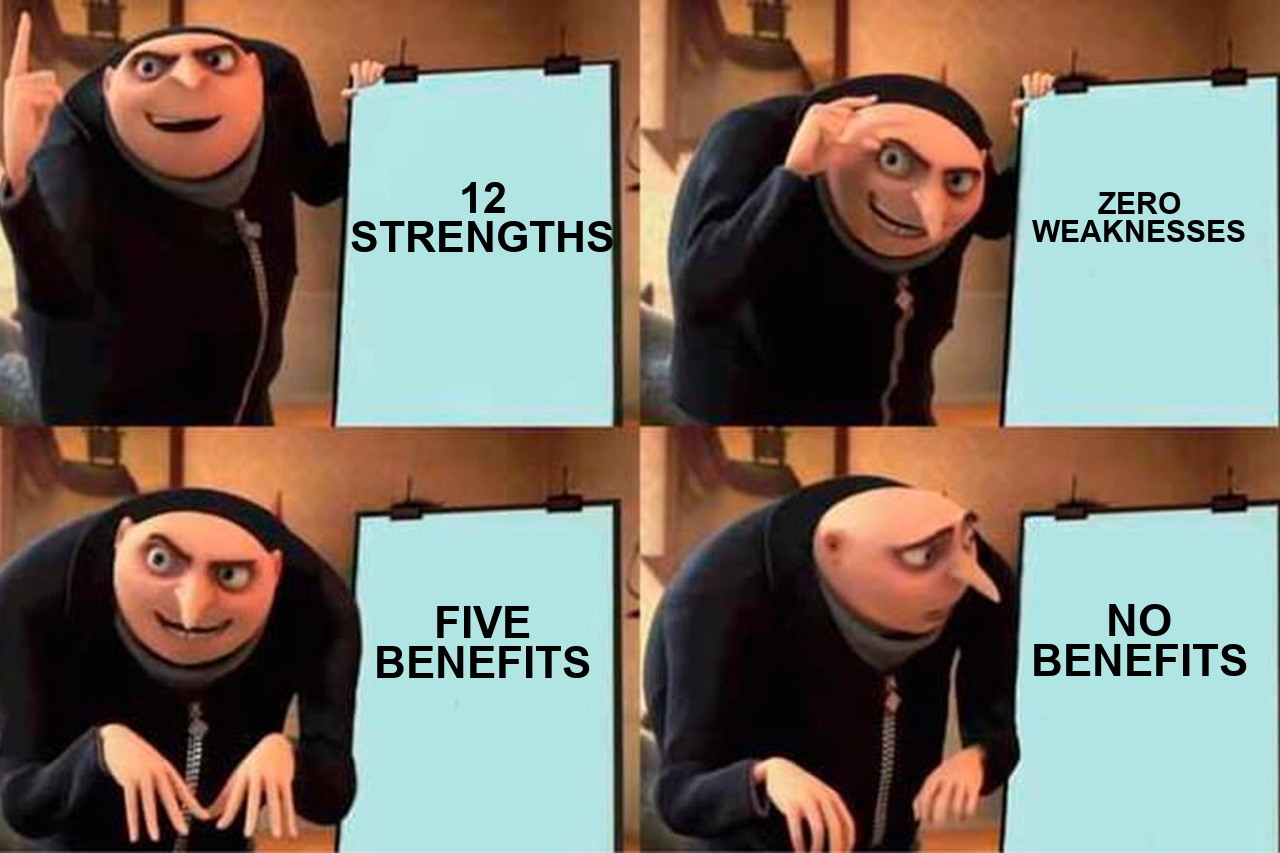
Five benefits equal no benefits.

GAO sustained a protest after CMS documented 12 strengths, no weaknesses, and five benefits, then concluded that the quotation offered no benefits.

Gru's Plan meme progressing through 12 strengths, zero weaknesses, five benefits, and the confused conclusion no benefits.
Twelve strengths. Zero weaknesses. Five benefits. No benefits.

What happened

GAO publicly posted DAS Federal on August 27; the protected decision is dated July 31. CMS had evaluated quotations for hosting, operating, and maintaining its integrated surveyor training system. GAO found that CMS applied unstated criteria when it penalized DAS's corporate experience narrative for not proposing a risk matrix, mitigation strategies, and task-specific performance metrics that the solicitation did not require in that section.

The same evaluation record assigned DAS 12 strengths and no weaknesses under the solution narrative factor. Five strengths expressly described benefits, yet the evaluators and source selection authority concluded that the quotation yielded no benefits or improvements beyond the baseline. GAO sustained the protest because the record did not reconcile those contradictory findings.

Why CMCoE cares

Adjectival ratings are only guides. Evaluators and source selection officials must use the stated criteria, distinguish experience from a proposed solution, and reconcile material contradictions in the underlying findings before relying on them in a best-value tradeoff.

Regulatory fine print

GAO did not reevaluate the quotations, direct award to DAS, or hold that every assessed strength must produce a higher confidence rating. It recommended reevaluation, a new documented best-value tradeoff and source selection decision, and reimbursement of reasonable protest costs. The decision's date is July 31; August 27 is the public posting date.

Sources

  1. GAO - DAS Federal, LLC, B-424464 et al. (U.S. Government Accountability Office, )
Commercial space / data licensing

We bought the data. Who has the invite?

GAO found that potential Space Force users were not engaged with the monthly group that could resolve concerns about data the government had already purchased.

Bernie Sanders once-again meme asking how to use commercial space data the government already bought.
How to use the data we already bought.

What happened

GAO reported on August 27 that the Space Force's Joint Commercial Operations Cell spent $76.8 million through a contractor-operated Global Data Marketplace from January 2023 through September 2025. The purchases supported missions including space domain awareness and tactical surveillance, reconnaissance, and tracking.

Some Space Force officials hesitated to buy or use commercial data because of licensing costs, perceived use restrictions, and concerns about long-term access. JCO runs a monthly cross-government working group that coordinates purchases, and GAO found that many reported concerns could have been addressed there, but the relevant Space Force officials were not participating and information about the group was not widely available.

Why CMCoE cares

Buying commercial data is only the first acquisition step. License scope, sharing rights, discoverability, user onboarding, and long-term access determine whether a purchased data service becomes an operational capability or an invoice with no obvious front door.

Regulatory fine print

GAO did not conclude that the entire $76.8 million was wasted, that purchased data were unusable, or that every official lacked access. It made one open recommendation to improve awareness of the working group and explain how current and potential users can access and use data and services government entities have purchased. DOD agreed and described planned outreach.

Sources

  1. GAO - DOD use of commercial space data and related services (U.S. Government Accountability Office, )
Navy readiness / depot capacity

Retirement has a dry-dock waitlist.

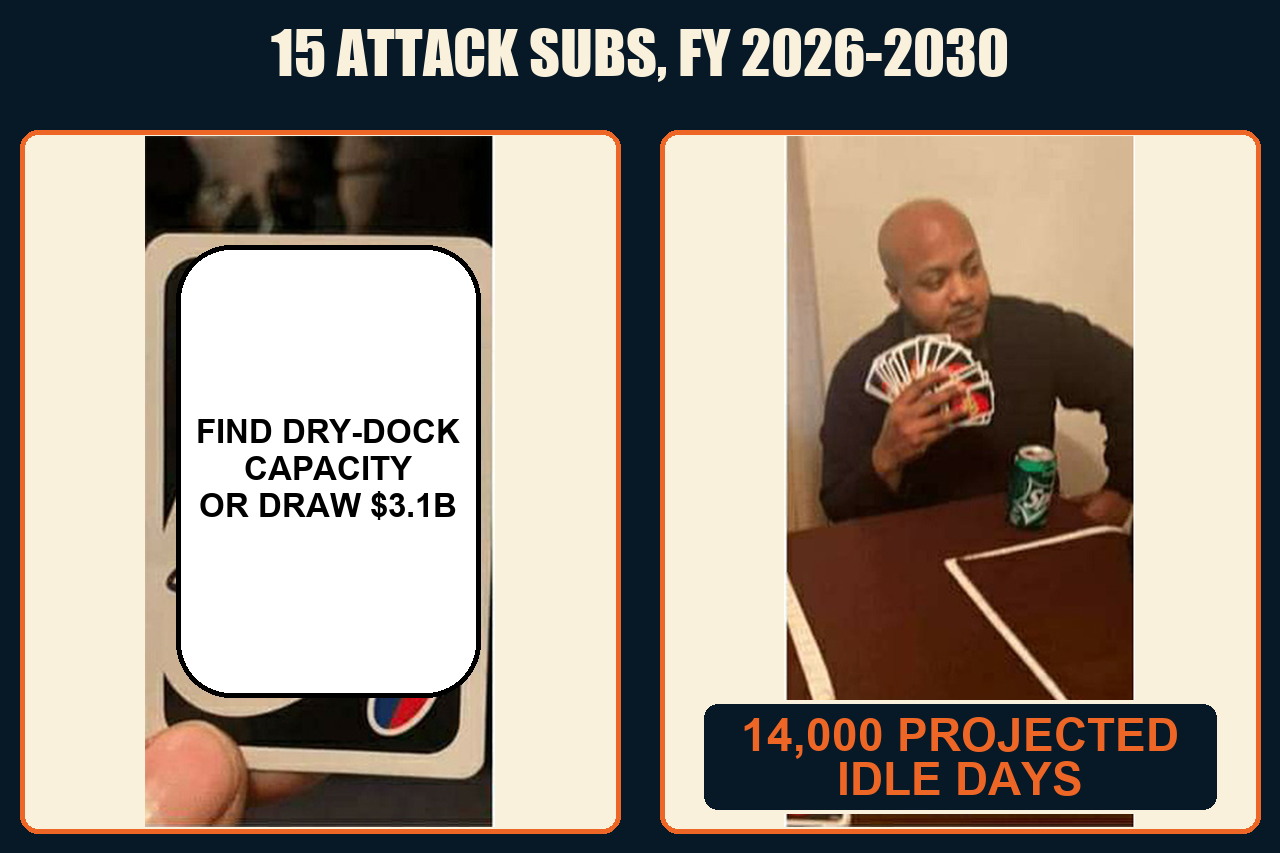
GAO projected that 15 attack submarines awaiting decommissioning could accumulate more than 14,000 inactive idle days and $3.1 billion in costs.

UNO Draw 25 meme asking the Navy to find dry-dock capacity or draw $3.1 billion, beside 14,000 projected idle days.
Find dry-dock capacity or draw $3.1 billion.

What happened

GAO's August 27 public report found that attack submarine maintenance delays and active idle time caused more than 15,000 lost operational days from fiscal years 2016 through 2025 and an estimated $3.4 billion in costs to sustain crews and submarines that provided no operational capability.

A separate decommissioning backlog is growing. GAO projected that 15 attack submarines will enter inactive idle time from fiscal years 2026 through 2030 because shipyards lack dry-dock capacity to begin reactor defueling. Without mitigation, the Navy could incur more than 14,000 inactive idle days and $3.1 billion in operating and support costs.

Why CMCoE cares

Depot and inactivation capacity are portfolio acquisition constraints. A submarine waiting to retire can still consume crew, support funding, and scarce shipyard attention while producing no operational availability, so decommissioning plans compete with maintenance and modernization for the same industrial capacity.

Regulatory fine print

The $3.1 billion and 14,000 days are GAO projections for fiscal years 2026 through 2030, not costs already incurred. GAO recommended evaluating alternatives such as defueling outside dry docks or reducing crews and then implementing an inactivation plan. The Navy verbally concurred but did not provide written comments. The public report is a redacted version of a classified report issued July 16.

Sources

  1. GAO - Navy attack submarine maintenance challenges (U.S. Government Accountability Office, )
Army software / acquisition pathways

Agility is now mandatory.

Army Directive 2026-19 makes the Software Acquisition Pathway mandatory for all Army software development while directing commercial-first buying and rapid-delivery practices.

Anakin and Padme four-panel meme pairing the Army's agile software goal with a mandatory Software Acquisition Pathway and asking whether agile means flexible.
Agile means flexible, right?

What happened

Federal News Network reported on August 27 on Army Directive 2026-19, which is dated July 22 and was published the prior week. The directive applies to software acquisition efforts across the Regular Army, Army National Guard, and Army Reserve and makes the Software Acquisition Pathway mandatory for all software development, including mixed efforts with software components.

Program managers may use the pathway as the primary pathway or with other pathways, and programs currently on another pathway are to transition at the next major decision point. The directive also calls for enterprise software contracts when available, commercial solutions first, configured commercial solutions second, and custom development only when no commercial option meets a significant portion of operational needs. It directs testing and cybersecurity processes to enable rapid delivery through automation, vendor test data when feasible, continuous authorities to operate, and reciprocity.

Why CMCoE cares

The policy changes pathway planning, market research, acquisition strategy, test integration, cybersecurity authorization, and the practical role of CSOs and OTs in Army software. Teams must now reconcile a mandatory framework with the tailoring and iteration that software programs need.

Regulatory fine print

This is an Army policy directive, not a statute, FAR or DFARS rule, or standalone contract authority. Mandatory use of the Software Acquisition Pathway does not mean it must operate alone; the directive expressly permits using it with other pathways. Custom development is strongly disfavored, not categorically prohibited. The directive is to be incorporated into a new Army regulation within two years.

Sources

  1. Army Directive 2026-19 - Enabling Modern Software Acquisition Practices (U.S. Army Publishing Directorate, )
  2. Federal News Network - Army overhauls software acquisition to speed delivery (Federal News Network, )
Army contracting / workforce integration

The radical reform is calling contracting first.

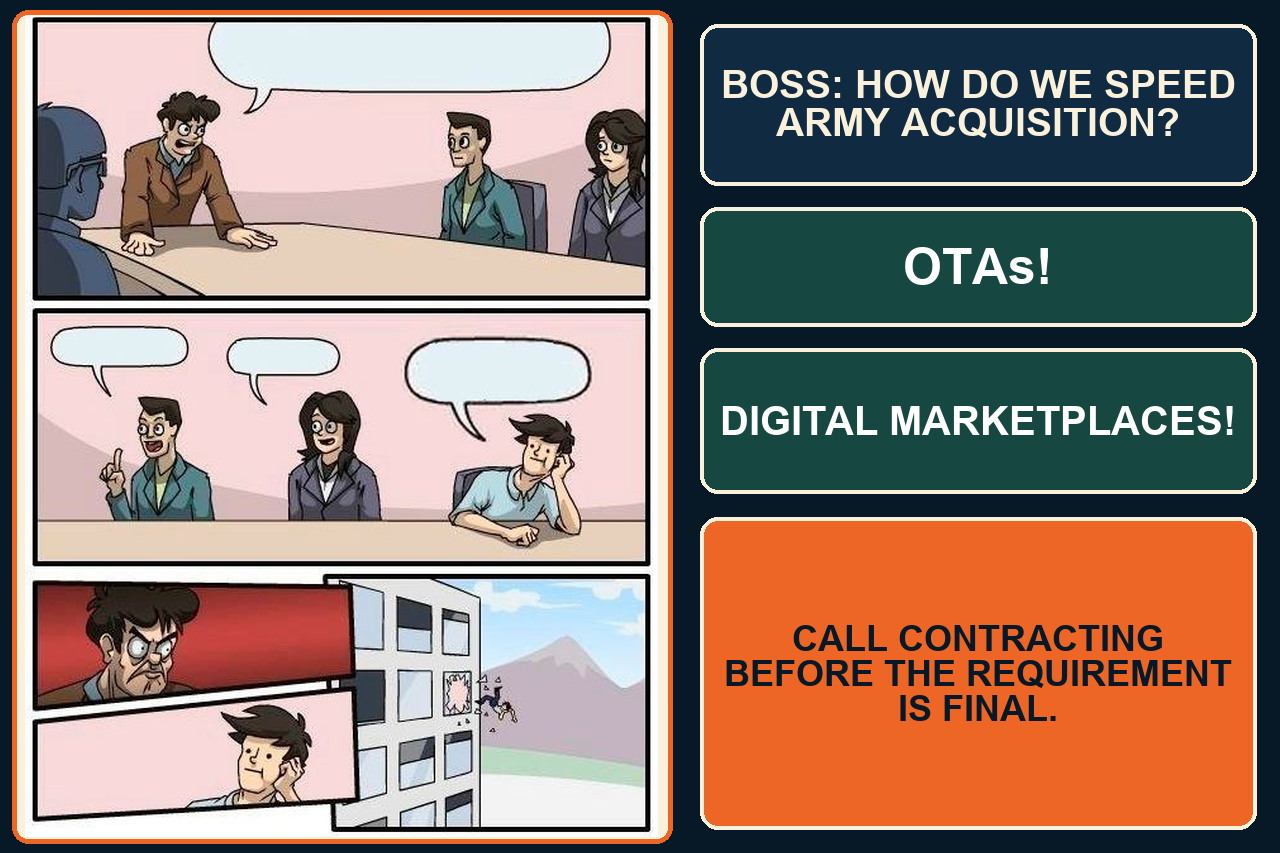
Army leaders highlighted OTAs, CSOs, digital marketplaces, and a still more disruptive idea: integrating contracting strategists before requirements become a final administrative handoff.

Boardroom Suggestion meme asking how to speed Army acquisition, accepting OTAs and digital marketplaces, and throwing out the suggestion to call contracting before the requirement is final.
Call contracting before the requirement is final.

What happened

An official Army feature published August 27 described Army Materiel Command and Army Contracting Command efforts to use OTAs, Commercial Solutions Openings, and digital marketplaces to reduce lead times and expand industrial capacity. It highlighted Project Integration, also called The PIT, which embeds contracting officers and program managers with operational units.

The Assistant Secretary of the Army for Acquisition, Logistics and Technology said contracting strategists must be integrated at the start of operational requirements rather than treated as a final administrative step. AMC leadership summarized the institutional importance even more directly: readiness begins and ends with a contract.

Why CMCoE cares

Early contracting involvement is where market research, competition strategy, data rights, funding, evaluation design, and realistic schedules can still shape a requirement. Innovative authorities cannot recover all the time lost when the acquisition team receives a finished solution instead of an operational problem.

Regulatory fine print

The source is an official Army feature describing leadership statements and ongoing initiatives, not a new binding regulation, independent audit, or measured finding that every cited effort delivers in days. OTAs, CSOs, and digital marketplaces each have distinct statutory or policy conditions; the article does not make them interchangeable.

Sources

  1. U.S. Army - AMC leaders highlight contracting reforms driving Army modernization (U.S. Army, )
Bid protest / material amendments

Amendment 0004 did not eat Amendment 0003.

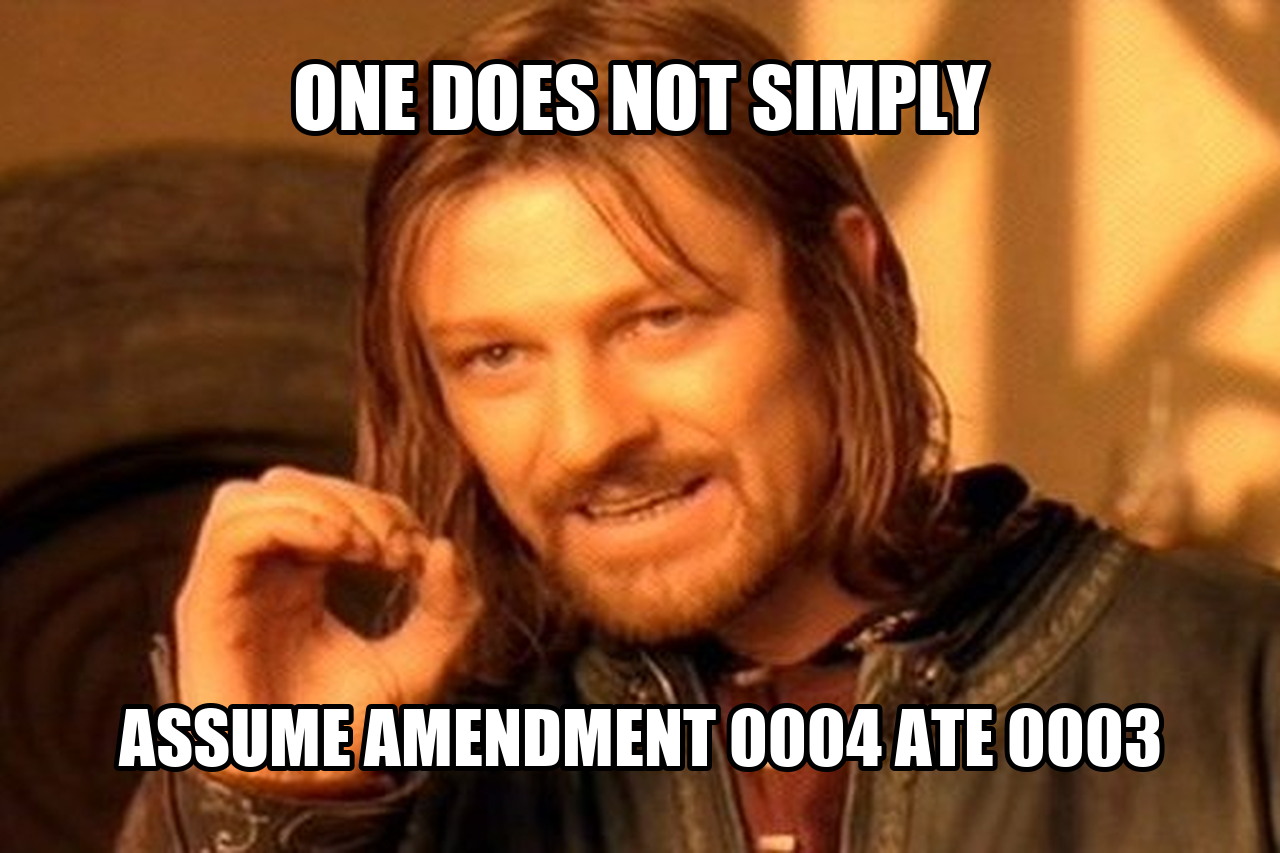
GAO denied a protest where the offeror acknowledged Amendment 0004 but not material Amendment 0003, which 0004 had not superseded.

One Does Not Simply meme saying one does not simply assume Amendment 0004 ate Amendment 0003.
Amendment 0004 did not eat Amendment 0003.

What happened

GAO publicly posted Hair By Allure on August 27; the decision is dated August 26. The VA's fixed-price, multiple-award IDIQ solicitation for orthotic softgoods and prosthetic supplies had four amendments. Amendment 0003 added previously unavailable estimated product quantities, imposed a price condition for products also offered through the Federal Supply Schedule, added two attachments, removed five, and updated six.

Amendment 0004 arrived the next day and replaced only one minimum-technical-requirements attachment. The protester acknowledged 0004 but not 0003 and argued that the later amendment superseded the earlier one. GAO found 0003 material because its quantity and pricing terms could affect offerors' prices, found that 0004 did not supersede those terms, and denied the protest.

Why CMCoE cares

Amendment control is proposal compliance, not clerical housekeeping. Offerors must trace which pages and terms each amendment changes, and agencies need amendment packages clear enough that supersession, replacement, and cumulative terms are not left to inference.

Regulatory fine print

GAO applied the general rule that failure to acknowledge a material amendment renders a proposal unacceptable, but materiality and supersession turn on the facts. The decision does not hold that a later amendment can never replace an earlier term. Here, 0004 replaced one attachment and left the material quantity and FSS-related pricing terms from 0003 in place.

Sources

  1. GAO - Hair By Allure, LLC d/b/a Allure Rejuvenation Center, B-424563 (U.S. Government Accountability Office, )
Bid protest / experience and past performance

One experience gate was not enough.

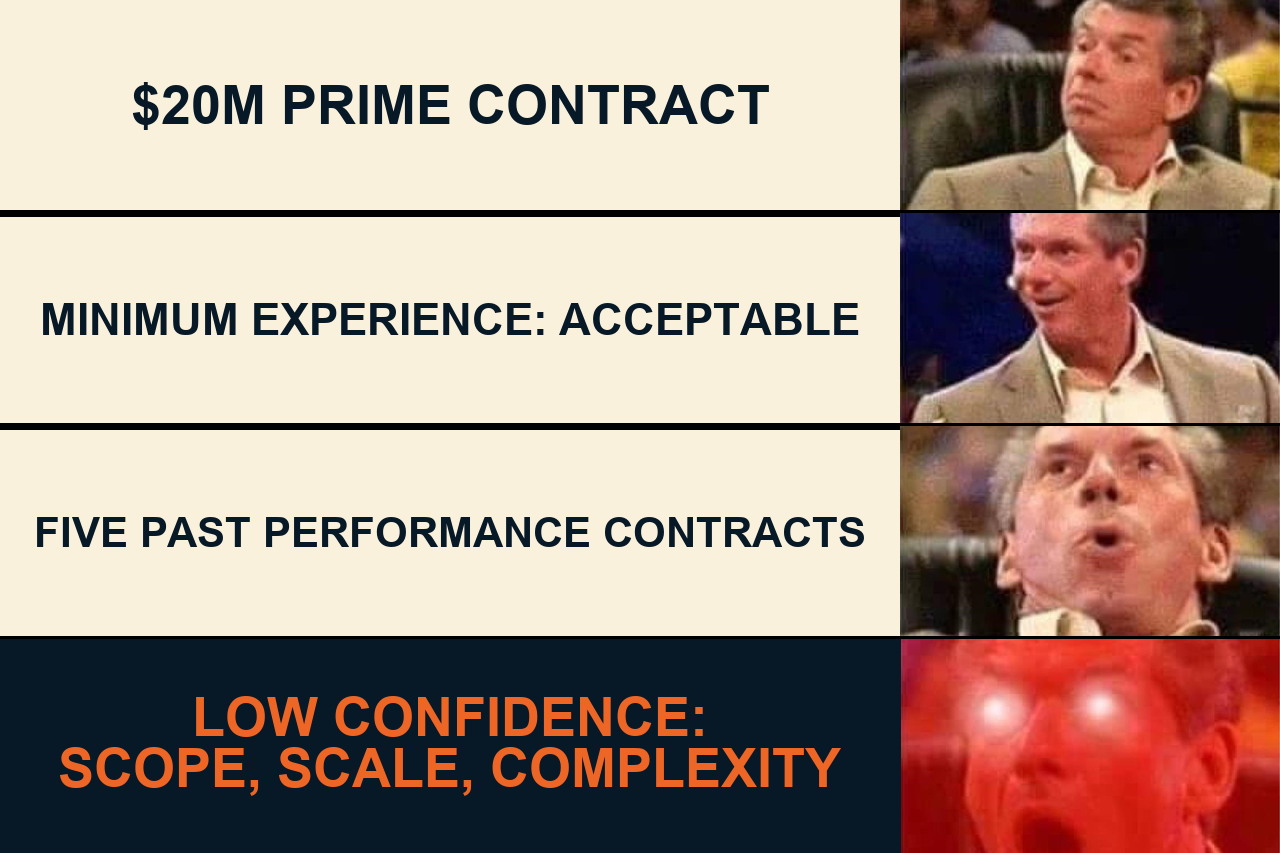
A vendor passed NIH's $20 million minimum-experience threshold, then received low confidence under the separate past-performance factor for scope, scale, and complexity.

Vince McMahon reaction progression moving from a 20 million dollar prime contract to acceptable minimum experience, five past-performance contracts, and low confidence for scope, scale, and complexity.
$20M experience gate: pass. Past performance gate: low confidence.

What happened

GAO publicly posted ShorePoint on August 27; the decision is dated August 24. NIH used FAR subpart 8.4 procedures for a fixed-price cybersecurity operations order. A separate minimum-experience factor required at least one federal prime contract with an annual value of at least $20 million and was rated acceptable or unacceptable.

The past-performance factor separately required three to five similar contracts demonstrating ability to perform work of the requirement's magnitude and complexity. ShorePoint passed minimum experience and submitted five past-performance examples, but NIH assigned low confidence because the references reflected smaller scope, scale, and complexity. Since low confidence under any technical capability factor caused exclusion, NIH removed the quotation from award consideration, and GAO denied the protest.

Why CMCoE cares

Threshold experience and evaluated past-performance relevance can be separate gates even when both examine prior contracts. Acquisition teams need factor language that states what each gate measures, and vendors cannot assume that clearing a dollar threshold settles the relevance analysis.

Regulatory fine print

GAO did not establish a universal rule that minimum experience and past performance must examine the same things. It found this solicitation expressly required past performance relevant to magnitude and complexity and that NIH's judgment was reasonable. GAO also found the protest timely because the January brief explanation did not reveal ShorePoint's evaluation; the firm first learned it was technically unacceptable after the corrective-action award in May.

Sources

  1. GAO - ShorePoint, LLC, B-424200.2, B-424200.3 (U.S. Government Accountability Office, )