Daily acquisition brief // August 30, 2026

CMCoE Meme Intel: August 30, 2026

Three acquisition stories, three real meme templates, and one data-sharing fix hiding on a meeting invite.

3 storiesRSS feed
Commercial space / data licensing

The data-sharing fix was hidden in a meeting invite.

Space Force users hesitated over commercial-data access concerns while the monthly cross-government group that could help was not widely known to them.
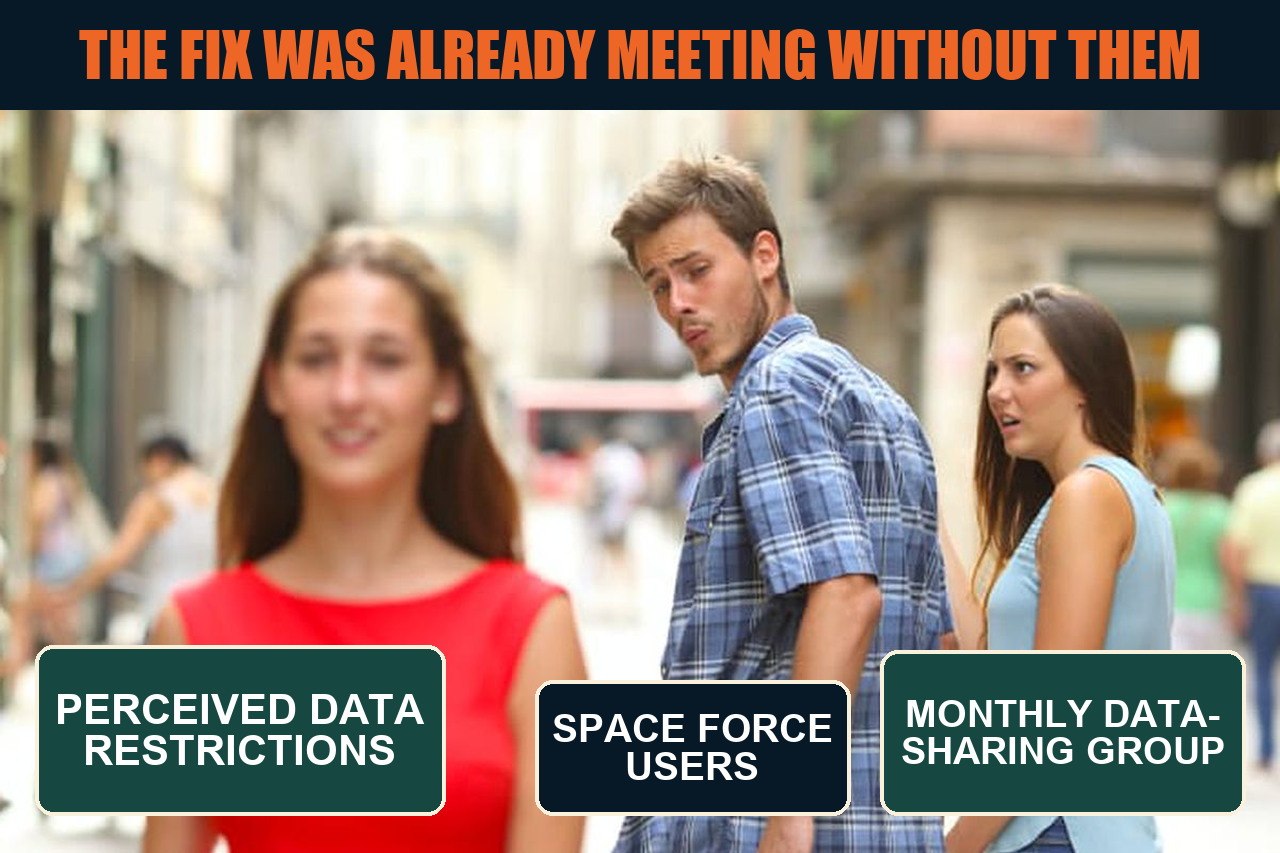
Distracted Boyfriend meme labeling Space Force users as distracted by perceived data restrictions while overlooking the monthly data-sharing group, with the payoff that the fix was already meeting without them.
The data-sharing fix was hidden in a meeting invite.

What happened

GAO reported on August 27 that the Space Force's Joint Commercial Operations Cell spent $76.8 million through its contractor-operated Global Data Marketplace from January 2023 through September 2025. Space Force officials nevertheless described hesitation to purchase and use commercial space data because of licensing costs, perceived use restrictions, and concerns about long-term access.

JCO already leads a monthly Cross-Government Commercial Data Sharing Working Group that coordinates purchases and discusses access issues. GAO found that many reported challenges could have been addressed there, but the relevant Space Force officials were not members and information about the group was not widely available. GAO recommended that the Secretary of the Air Force improve awareness of both the group and how to use data the government has purchased; DOD agreed.

Why CMCoE cares

Commercial-data acquisition succeeds only if license terms, reuse rights, access paths, and existing government purchases are visible to actual users. Buying data through a marketplace does not prevent duplicate purchases or adoption delays when the people with the questions cannot find the coordination forum with the answers.

Regulatory fine print

GAO issued a recommendation, not a binding procurement rule or a finding that every licensing concern was imaginary. The report calls some restrictions perceived and says many challenges could have been addressed through the working group; it does not say all commercial data were freely reusable or that the group could resolve every access issue.

Sources

  1. GAO - National Security Space: DOD Has Opportunities to Improve Its Use of Commercial Data and Related Services (U.S. Government Accountability Office, )
Bid protests / LPTA pricing

LOGMET corrected itself out of first place.

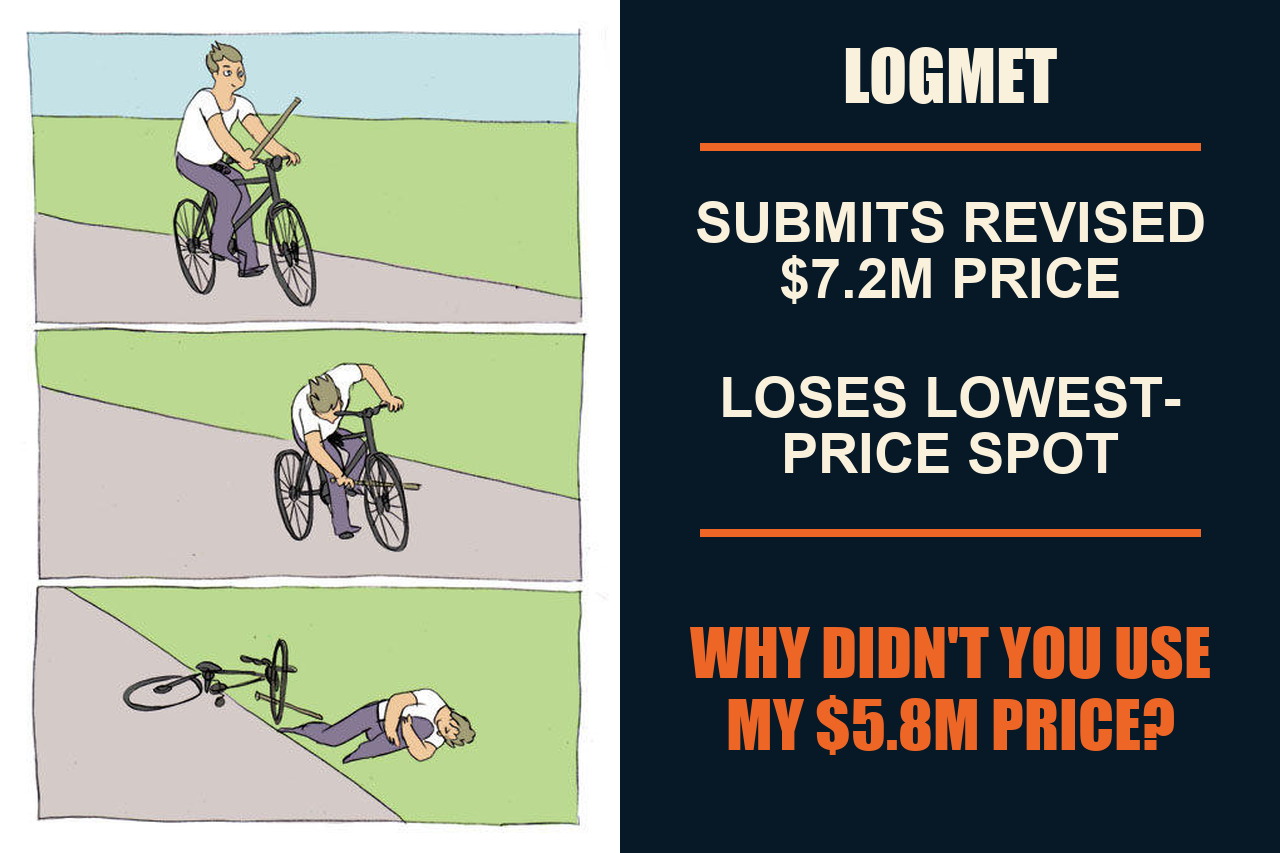
A required schedule correction raised LOGMET's quote from $5.8 million to $7.2 million, so its quotation was no longer first in the LPTA queue.

Bike Fall meme showing LOGMET submitting a revised $7.2 million price, losing the lowest-price spot, and then asking why the Coast Guard did not use its earlier $5.8 million price.
LOGMET corrected itself out of first place.

What happened

In a Coast Guard fixed-price LPTA procurement for aircraft and aviation life-support maintenance, only the lowest-priced quotation would proceed to technical acceptability and past-performance review. LOGMET initially quoted $5,771,306, but its schedule placed several option-year positions at the wrong location. The Coast Guard gave LOGMET and another affected vendor the choice to correct their schedules or leave award consideration.

LOGMET submitted a revised quotation for $7,198,870. That put it above SkyQuest's $5,942,408 quote, which the Coast Guard found technically acceptable with satisfactory past performance. LOGMET then argued that the agency should not have treated the revised price as superseding its original. GAO denied the protest, finding that LOGMET submitted the revision without reserving the old price and that the noncompliant original would otherwise have been removed from consideration.

Why CMCoE cares

In a sequential LPTA evaluation, a price correction can determine whether the agency ever reaches a vendor's technical quotation. A revised quotation is not a side note to the earlier version, and a vendor that disagrees with an agency's solicitation interpretation during corrective exchanges must raise that issue before accepting the requested revision and waiting for award.

Regulatory fine print

The Coast Guard did not calculate or unilaterally substitute LOGMET's higher price; LOGMET submitted the revised quotation after being told the schedule had to be corrected. GAO reviewed this record under the standards for simplified acquisition procedures and denied the protest. The decision does not establish that every post-closing price correction is permissible or that every revision automatically resolves unequal-treatment concerns.

Sources

  1. GAO - LOGMET LLC, B-424477, B-424477.2 (U.S. Government Accountability Office, )
  2. GAO - Recent Bid Protest Decisions (U.S. Government Accountability Office, )
Bid protests / subcontract jurisdiction

DIA made the call. GAO could not take it.

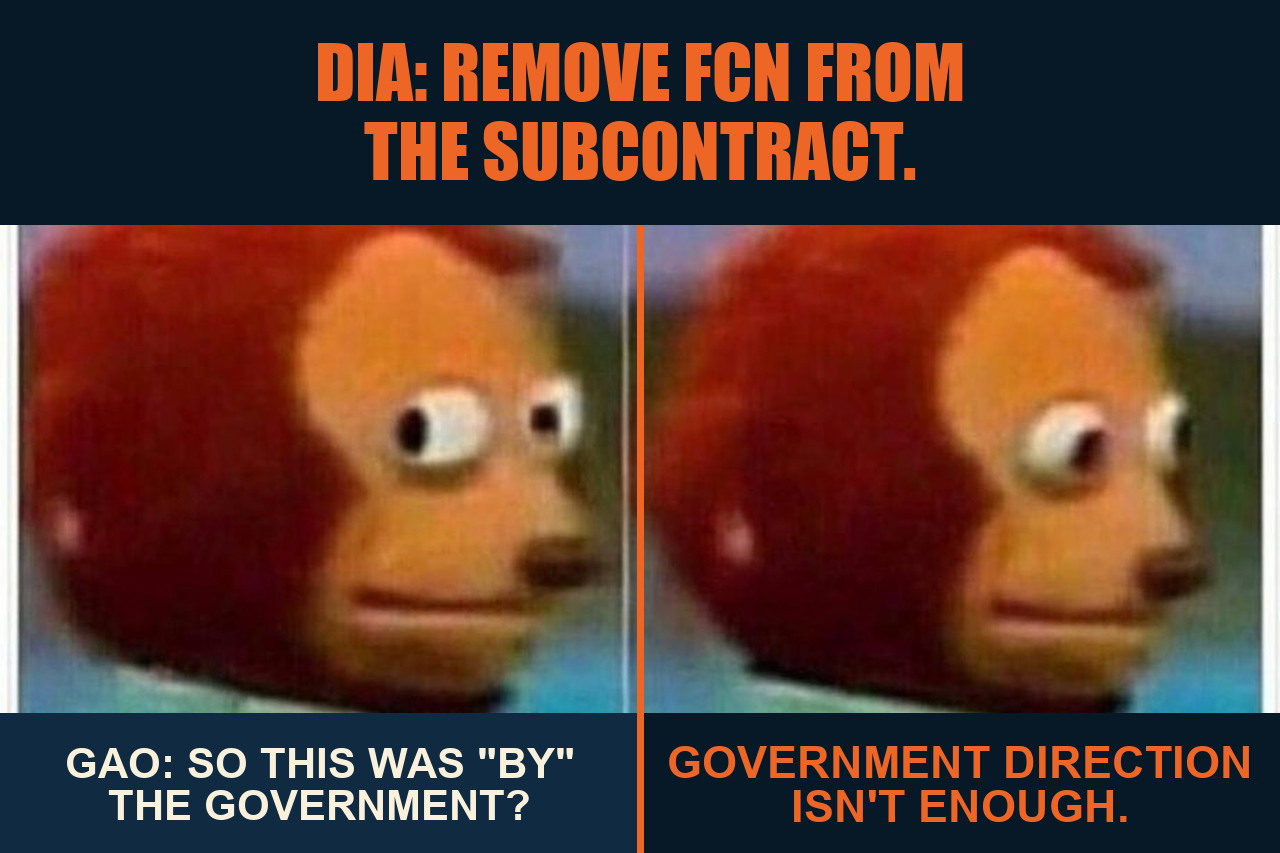
DIA directed a prime to remove FCN, but GAO held that government direction alone did not make the subcontract procurement a procurement by the government.

Awkward Monkey Puppet meme in which DIA directs FCN's removal, GAO asks whether the subcontract was therefore by the government, and the reaction says government direction is not enough.
DIA made the call. GAO could not take it.

What happened

FCN was competing as a prospective subcontractor to Invictus under a Defense Intelligence Agency SITE III task-order effort. After considering a potential organizational conflict of interest, the contracting officer asked Invictus to remove FCN from that solicitation and two other procurement actions. Invictus told FCN that the government customer had instructed the removal.

GAO dismissed FCN's protest without reaching the merits of the OCI determination. FCN was not an interested party under CICA because it was competing for a subcontract, not the federal task order. GAO also declined its narrow subcontract jurisdiction: Invictus had prepared the subcontract solicitation and criteria, evaluated quotations, and retained supplier-selection responsibility, so DIA's outcome-changing direction alone did not make Invictus a mere conduit for a procurement by the government.

Why CMCoE cares

Government influence over a subcontract outcome does not necessarily create GAO jurisdiction. Prospective subcontractors must distinguish direct commercial harm from statutory interested-party standing and must assess whether the agency actually took over substantially all substantive aspects of the subcontract procurement.

Regulatory fine print

This was a jurisdictional dismissal, not a decision that DIA's OCI analysis or FCN's exclusion was reasonable. GAO's exception for subcontracts awarded by the government is fact-specific and applies when the agency handles substantially all substantive procurement functions. The decision also notes that the Court of Federal Claims separately found FCN lacked standing as a subcontractor to enforce a CICA stay.

Sources

  1. GAO - FCN Inc., B-424695 (U.S. Government Accountability Office, )
  2. GAO - Recent Bid Protest Decisions (U.S. Government Accountability Office, )