Daily acquisition brief // September 1, 2026

CMCoE Meme Intel: September 1, 2026

Three fresh acquisition contradictions: one unmeasured cutover, one OEM-witnessed software handoff, and one integrator for separate launcher awards.

3 storiesRSS feed
Telecommunications / transition oversight

GSA finished the cutover before measuring the outages.

GAO says GSA managed 221 agencies off legacy telecom contracts but still does not know whether selected agencies lost service.
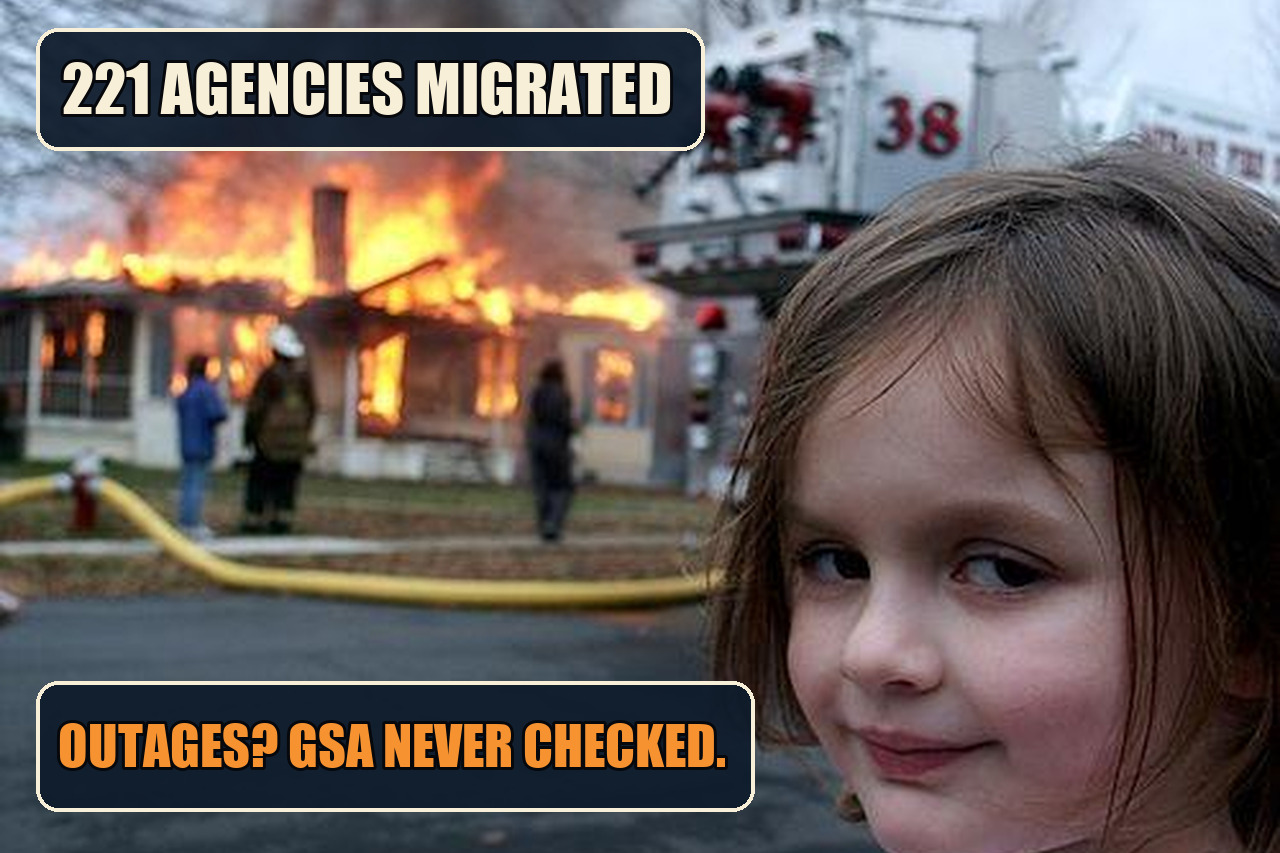
Disaster Girl meme with the setup 221 agencies migrated and the payoff Outages? GSA never checked.
221 agencies migrated. Outages? GSA never checked.

What happened

On August 31, GAO reported that GSA had managed 221 agencies' transitions from expired legacy telecommunications contracts to the replacement Enterprise Infrastructure Solutions contract. The six agencies GAO selected for review completed their transitions more than three years after GSA's September 2022 revised deadline, and GSA extended the legacy contracts through May 2026 at the latest to avoid service disruptions.

The six selected agencies' combined Networx bill increased 206 percent from February to March 2025. GAO also found that GSA did not know whether all selected agencies experienced service disruptions, in part because it was not notified whether replacement service was operating before legacy service was disconnected. GAO recommended a post-transition assessment, and GSA concurred.

Why CMCoE cares

A contract transition is not fully understood when the agency cannot connect cutover activity to service-continuity outcomes. Post-transition evidence can shape contingency planning, transition requirements, vendor oversight, and the follow-on acquisition before another bridge period raises legacy costs.

Regulatory fine print

GAO did not find that every selected agency suffered an outage, and it did not assess every one of the 221 agencies in detail. Its review focused on six agencies with substantial transition work remaining as of September 2024. The recommendation asks GSA to determine whether at least those selected agencies experienced disruptions and whether mitigation worked.

Sources

  1. GAO - Telecommunications: GSA Should Assess Agencies' Effectiveness at Preventing Service Disruptions, GAO-26-107919 (U.S. Government Accountability Office, )
Software sustainment / source control

The Air Force brought rescue-helicopter software in-house, with an OEM witness.

Robins declared organic sustainment for 22,000-plus lines of HH-60W maintenance code after testing and OEM build verification.

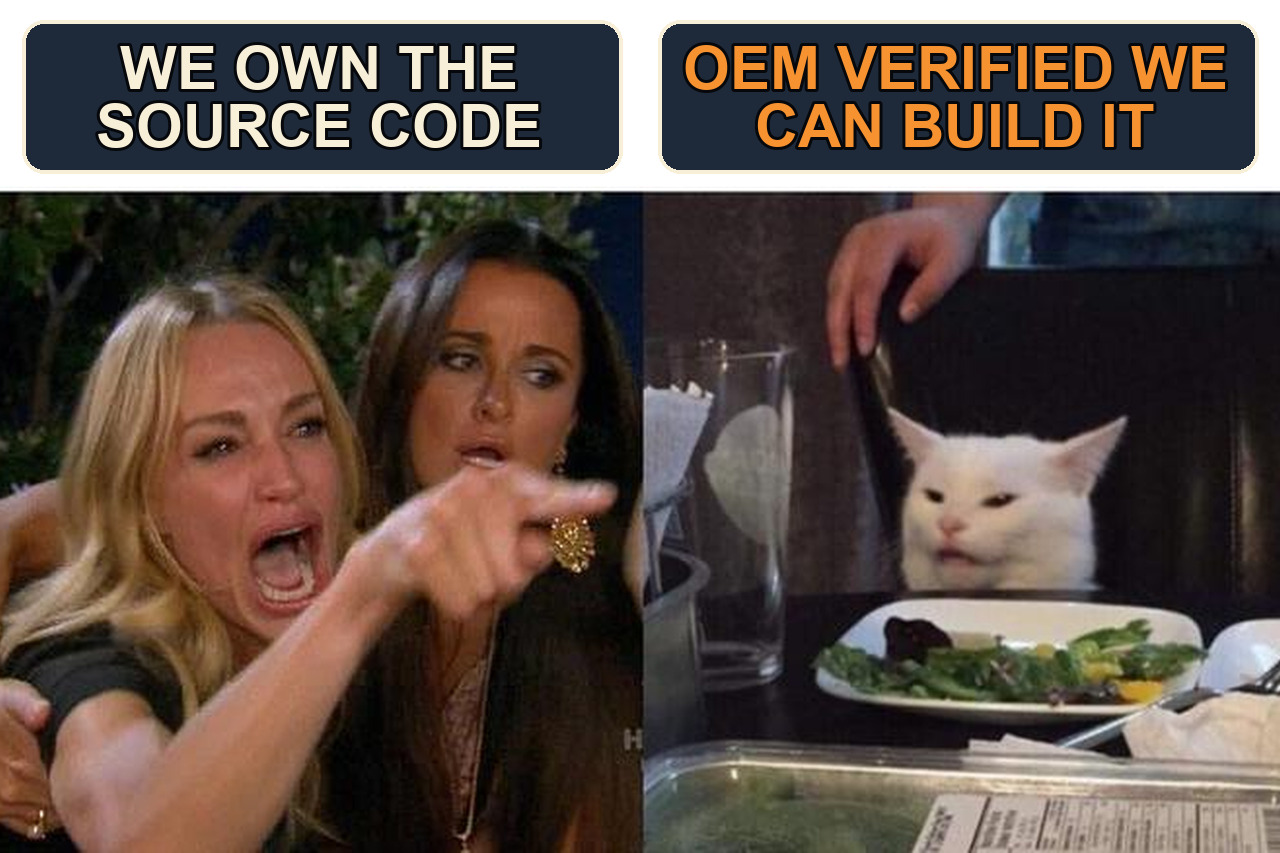
Woman Yelling at a Cat meme in which the woman says We own the source code and the cat replies OEM verified we can build it.
We own the source code. OEM verified we can build it.

What happened

The Air Force announced on August 31 that the 580th Software Engineering Squadron had declared Initial Depot Capability on August 25 for the HH-60W combat rescue helicopter's Maintenance Data Interface. The software contains more than 22,000 lines of code and translates aircraft health data, including engine temperatures and airframe stresses, into diagnostic information for ground crews.

The squadron says it has complete ownership and control of the MDI source data and can now provide updates and troubleshooting without relying on outside contractors. Its stand-up included a Formal Qualification Test with a 99.74 percent pass rate and an original equipment manufacturer verification proving that the squadron could build the code to industry standards.

Why CMCoE cares

Source access and an organic software depot can shorten the path from a fleet problem to a tested field fix. The milestone also shows that a software handoff needs more than files: the government must establish a repeatable build, test environment, qualified staff, and evidence that its output matches the operational baseline.

Regulatory fine print

The OEM verification was part of the transition evidence, not proof that the Air Force remains dependent on the OEM. The Air Force says the opposite: the squadron no longer needs outside contractors for updates or troubleshooting. The meme targets the optics of external verification during an independence milestone, not the value of qualification testing.

Sources

  1. Air Force Materiel Command - 580th SWES secures second landmark software milestone for combat rescue helicopter (U.S. Air Force, )
Prototype OTAs / modular integration

The Army separated the launcher awards, then centralized the interfaces.

A $33.4 million prototype OTA makes Georgia Tech the integrator for a launcher whose components will come through separate awards.

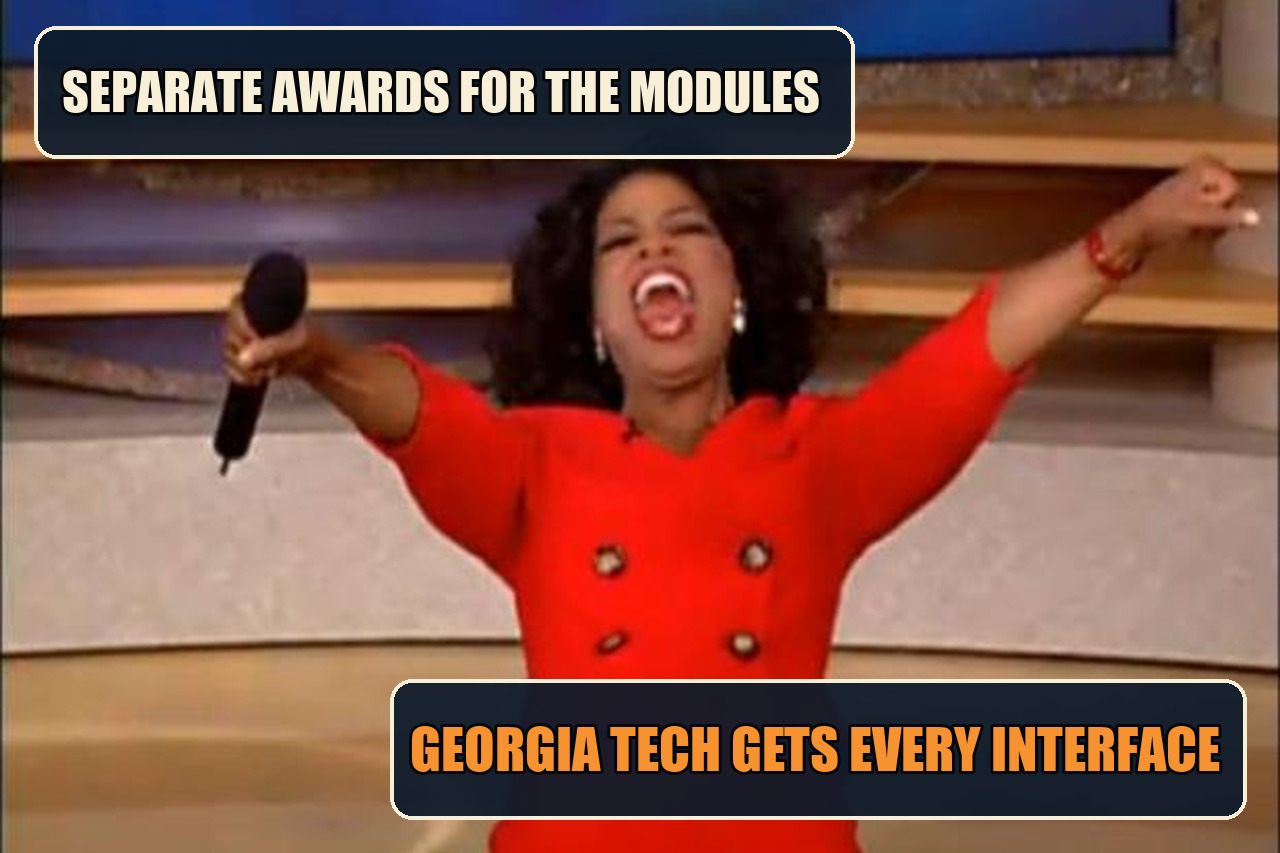
Oprah You Get a Car meme with the setup Separate awards for the modules and the payoff Georgia Tech gets every interface.
Separate awards for the modules. Georgia Tech gets every interface.

What happened

On August 31, the Army announced that it had awarded Georgia Tech Research Institute a prototype other transaction agreement on August 21 to serve as weapon systems integrator for the Common Autonomous Multi-Domain Launcher effort. The agreement has a maximum value of $33,399,920 and an expected period of about 36 months.

The Army says no single company will receive an award to develop the complete launcher. Instead, the autonomous mobility platform, modular munitions pallets, and other components will be acquired through separate awards, with more awards forthcoming. Georgia Tech will lead systems engineering, interface integration, modeling and simulation, and integrated testing so the independently acquired pieces function as one system.

Why CMCoE cares

Modular acquisition can broaden competition and let components evolve independently, but it moves technical and schedule risk into interfaces. A clearly empowered integrator, stable interface definitions, configuration control, and test authority become central acquisition choices when no full-system prime owns the whole launcher.

Regulatory fine print

This is a prototype OTA, not a production decision or an award for the complete launcher. The Army has not said that any component is incompatible or that integration has failed. Georgia Tech's role is the Army's deliberate mechanism for managing the interface risk created by separate component awards.

Sources

  1. U.S. Army - Army selects Georgia Tech Research Institute as Weapon Systems Integrator for CAML (U.S. Army, )