Daily acquisition brief // September 4, 2026

CMCoE Meme Intel: September 4, 2026

Three fresh acquisition reversals: avoided IT spending that changed vehicles, secure rooms that travel, and a disaster area that stretched across Tennessee.

3 storiesRSS feed
Contract terminations / cost avoidance

DHS's $10.5 billion in avoided IT costs kept the same requirements alive.

GAO found that most of the headline estimate came from terminated IT IDIQs while DHS used other governmentwide contracts for those requirements.
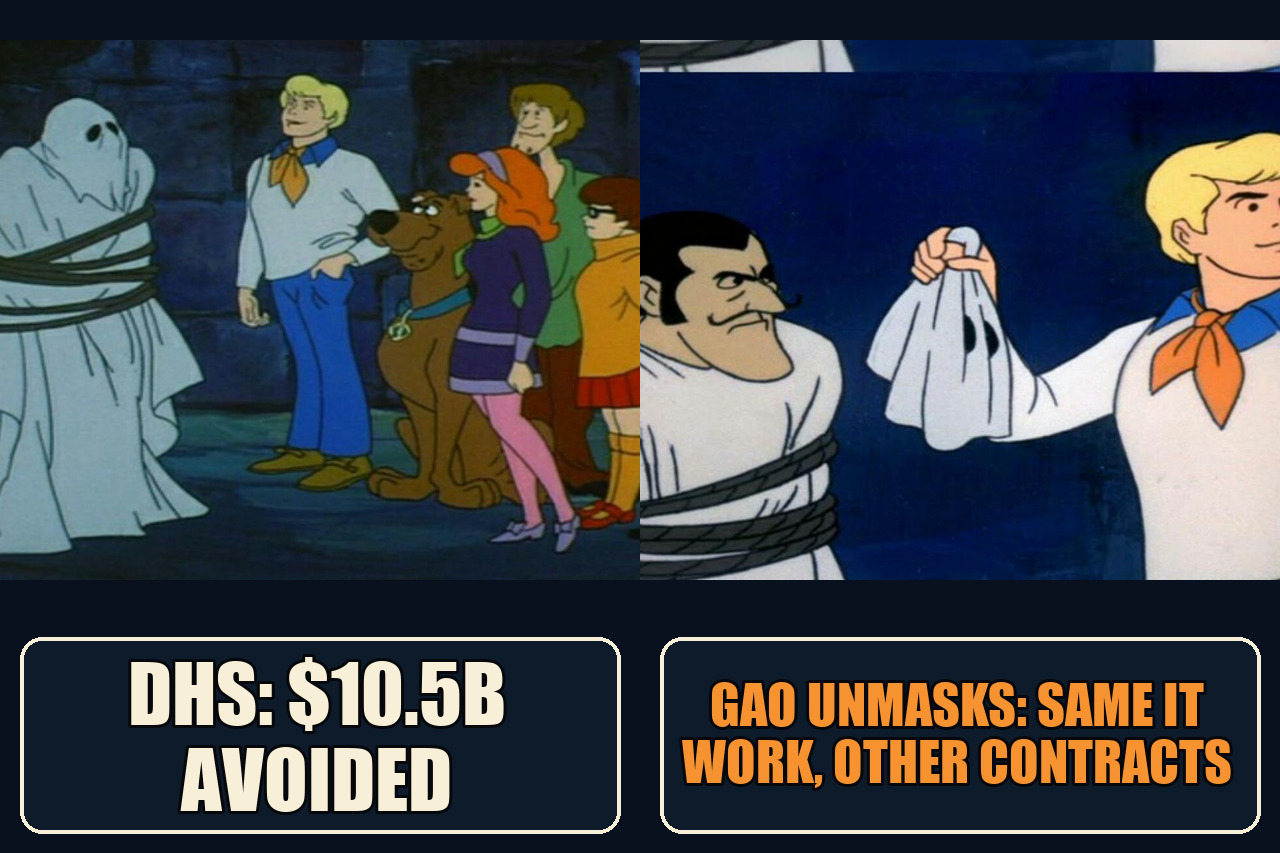
Scooby-Doo reveal meme with the setup DHS: $10.5B avoided and the payoff GAO unmasks: same IT work, other contracts.
DHS: $10.5B avoided. GAO unmasks: same IT work, other contracts.

What happened

On September 3, GAO reported that DHS had completely or partially terminated 438 contracts for convenience from January 20 through September 30, 2025, deobligating a net $92 million. DHS publicly estimated that the terminations could avoid $10.5 billion in current and future costs over the contracts' lifespans.

GAO found that 95 percent of the $10.5 billion estimate came from 30 terminated IT IDIQ contracts covering fiscal years 2025 through 2034. DHS obligated more than $1.7 billion in fiscal 2025 through existing governmentwide contracts to meet those requirements, and future obligations for the same requirements will further reduce actual cost avoidance.

Why CMCoE cares

A termination estimate is not the same as realized savings when the requirement survives and spending moves to another vehicle. Acquisition leaders need to separate deobligations, avoided future orders, replacement-vehicle obligations, and net savings before using a headline figure for portfolio decisions or oversight.

Regulatory fine print

The $10.5 billion was DHS's estimate of potential current and future cost avoidance, not a realized savings figure. The $1.7 billion was obligated in fiscal 2025 through existing governmentwide contracts to meet the IT requirements; it was not necessarily placed with the same vendors or under identical terms. The meme's 'same IT work' compresses GAO's phrase 'those requirements.'

Sources

  1. GAO - DHS Contracts: Reported Potential Cost Avoidance from Terminations Will Not Fully Materialize (U.S. Government Accountability Office, )

Industrial base / classified infrastructure

The new secure-work network puts roughly 50 SCIFs on the move.

The Department of War plans mobile classified facilities that can be positioned closer to suppliers and mission needs.

Roll Safe meme with the setup Can't be too far from the SCIF and the payoff If the SCIF drives to you.
Can't be too far from the SCIF if the SCIF drives to you.

What happened

On September 3, the Department of War announced the Secure Space Network, an effort to design, produce, and deploy approximately 50 mobile Sensitive Compartmented Information Facilities and related information systems across the United States.

The department says the rapidly deployable facilities can be positioned at military installations, APEX Accelerators, and other mission-relevant locations. The goal is to give more emerging and nontraditional suppliers access to accredited classified workspaces without requiring each company to establish fixed secure infrastructure.

Why CMCoE cares

Access to accredited secure space can be a practical barrier to competing for classified work. A shared, deployable network could broaden the supplier pool, but its acquisition and operating model still has to manage accreditation, scheduling, information systems, physical security, regional demand, and the transition from unclassified engagement into classified production.

Regulatory fine print

The release describes approximately 50 mobile SCIFs and related systems that can be positioned at selected sites; it does not promise door-to-door service for every supplier. 'Drives to you' personifies the mobile deployment model. The announcement did not state an award value, contractor, procurement instrument, or deployment schedule.

Sources

  1. Department of War - Secure Space Network (U.S. Department of War, )
Disaster contracting / local vendor preference

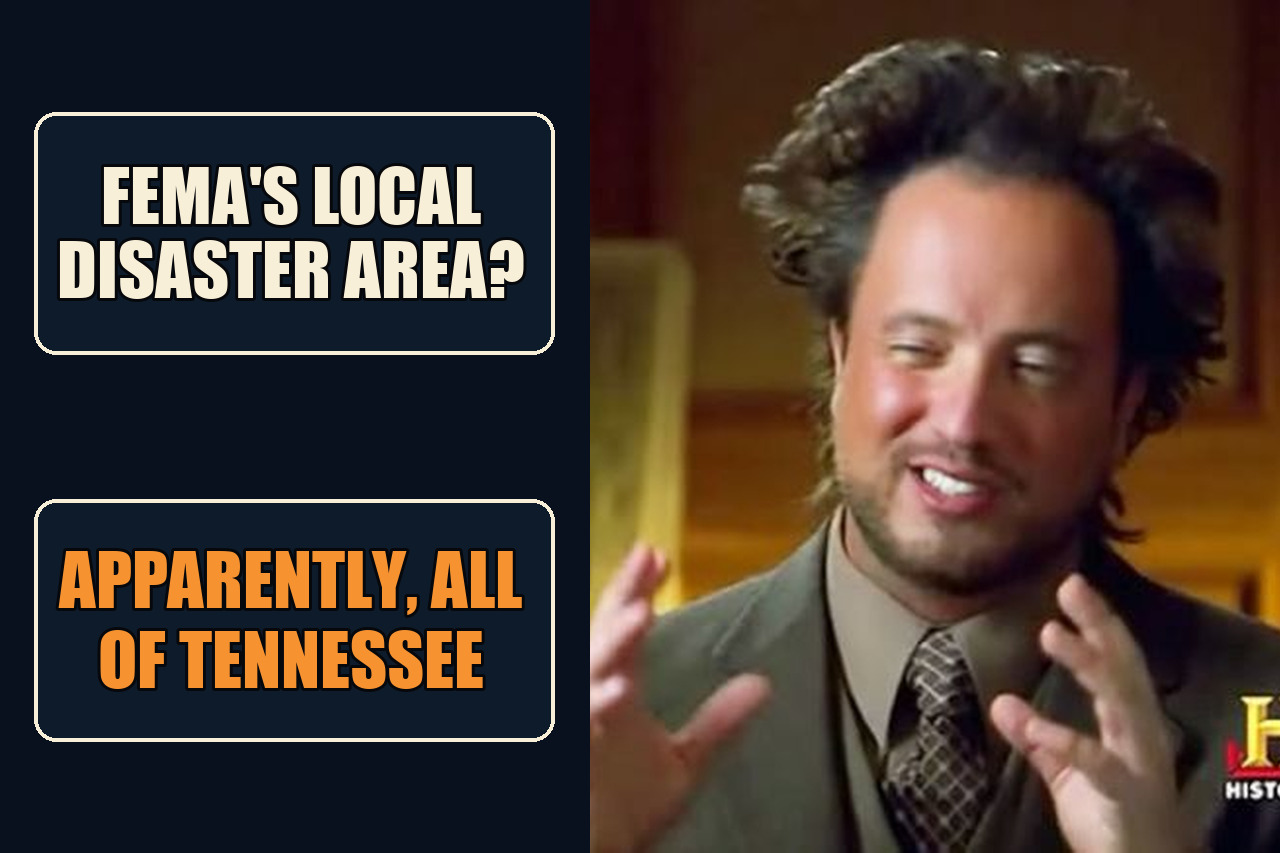
One FEMA buyer made the local disaster area all of Tennessee.

GAO found inconsistent disaster-area identification and no agencywide monitoring of local-vendor use.

Ancient Aliens meme with the setup FEMA's local disaster area? and the payoff Apparently, all of Tennessee.
FEMA's local disaster area? Apparently, all of Tennessee.

What happened

On September 3, GAO reported that FEMA and the Army Corps of Engineers had policies to promote local-vendor use after disasters but did not monitor the associated data, leaving both agencies unable to determine the extent of local contracting or its effect on economic recovery.

GAO found that contracting officers did not always understand how to identify the local disaster area, which is generally defined by the official presidential disaster declaration. One FEMA contracting officer used the entire state of Tennessee in anticipation that other areas might later be added. GAO also found all selected Corps contracts missing required justifications for awards to nonlocal vendors.

Why CMCoE cares

The local preference works only when buyers apply the declared boundary consistently and document exceptions. Overbroad geography can dilute the preference away from affected communities, while missing data and nonlocal-award justifications prevent leaders from checking whether disaster spending is supporting local economic recovery as intended.

Regulatory fine print

The Tennessee example came from one FEMA contracting officer interviewed in GAO's nongeneralizable review of three disasters. It does not describe every FEMA award or all of Tennessee's disaster status. GAO said the officer anticipated that additional areas might be added later; the meme targets the agency's guidance, training, and monitoring problem, not an individual employee.

Sources

  1. GAO - Disaster Contracting: FEMA and the Corps Have Opportunities to Improve Local Vendor Use (U.S. Government Accountability Office, )