Daily acquisition brief // September 17, 2026

CMCoE Meme Intel: September 17, 2026

Three control tells: $6.7 billion in paid leave tied to deferred resignations, paid debt screening that missed free federal data, and a travel-system administrator who changed reimbursement bank details to his own.

3 storiesRSS feed
Federal workforce / cost tracking

Deferred resignations generated an estimated $6.7 billion in paid administrative leave.

GAO says workforce-reduction leave drove most of a sixfold jump in federal administrative-leave salary costs during 2025, while OPM could not isolate the program's actual cost in its reporting system.

Trade Offer reaction frame with the setup I receive: your resignation and the payoff You receive: $6.7B in paid leave.
I receive: your resignation. You receive: $6.7B in paid leave.

What happened

GAO estimated that federal agencies spent $9.5 billion in salary costs for paid administrative leave in 2025, a sixfold increase from 2023. About $6.7 billion of the 2025 estimate was associated with the deferred resignation program.

Under that program, employees who agreed to resign or retire generally stopped working immediately but continued to receive pay through September 30, 2025. GAO found that OPM could not easily and accurately isolate workforce-reduction leave because it was reported with other general administrative leave, and the underlying data also included errors such as holidays recorded as administrative leave.

Why CMCoE cares

Workforce reductions are usually justified as long-term savings, but leaders need a reliable view of the short-term cost to test that claim. A dedicated reporting category would make the tradeoff visible instead of mixing it into a broad leave bucket.

Regulatory fine print

The $6.7 billion figure is GAO's estimate based on program assumptions and payroll-provider data, not an amount separately tracked by OPM. GAO said data errors could overstate total administrative leave, and the report does not determine whether the program produced net savings over time.

Sources

  1. GAO - Federal Workforce: Deferred Resignation Program Largely Responsible for Sixfold Increase in Paid Administrative Leave Salary Costs (U.S. Government Accountability Office, )
Loan guarantees / eligibility screening

EXIM paid for debt screening while free federal databases held more complete eligibility data.

GAO says the third-party database could not identify delinquent federal nontax debt, while EXIM lacked procedures to use SAM and Do Not Pay across its loan-guarantee approvals.

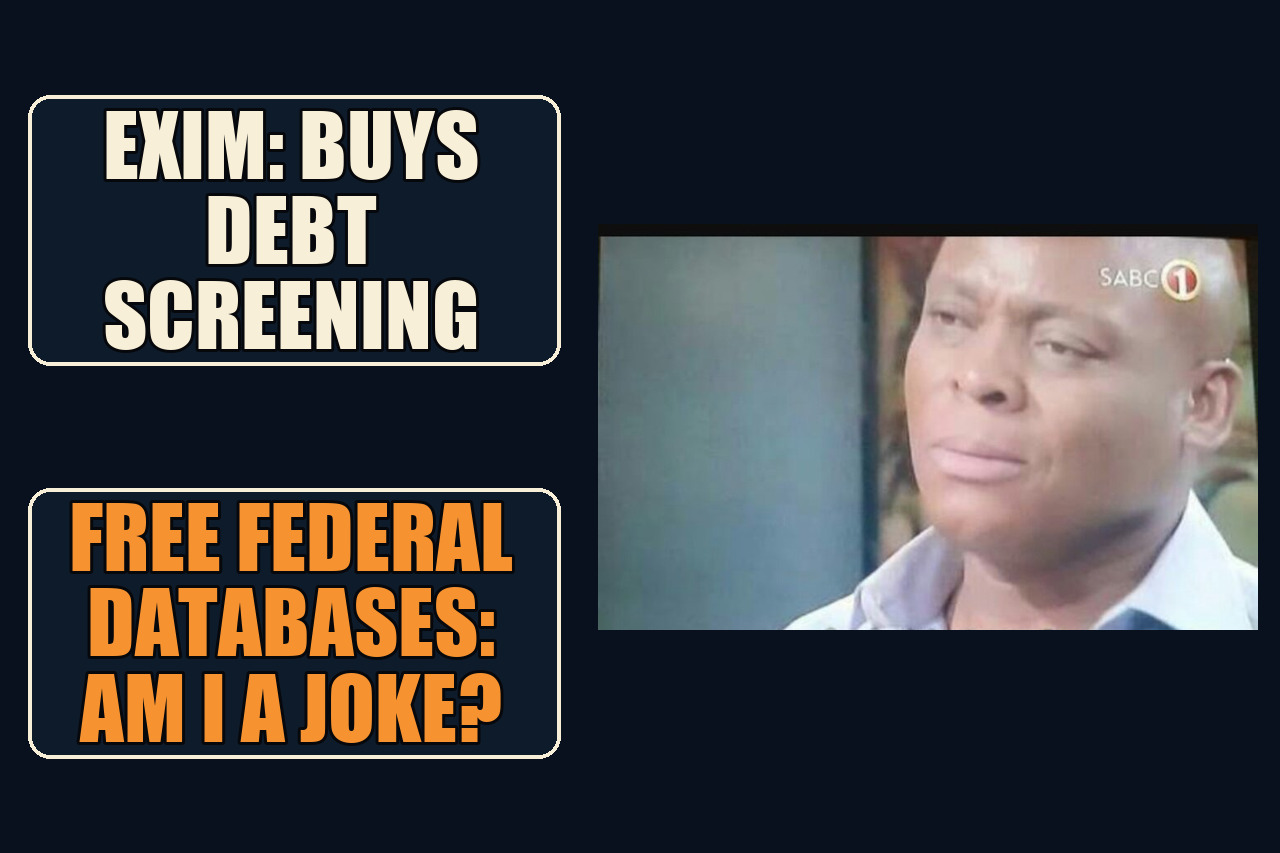
Am I a Joke to You reaction frame with the setup EXIM buys debt screening and the payoff Free federal databases: am I a joke?
EXIM: buys debt screening. Free federal databases: am I a joke?

What happened

GAO reported that EXIM has relied since April 2023 on a third-party vendor database to screen all loan-guarantee participants for delinquent federal debt. That database may identify some federal tax debt but does not identify delinquent federal nontax debt.

EXIM required a SAM Debt Subject to Offset check for transactions approved by its Board of Directors, but not for transactions approved by staff with individual delegated authority, and it had no procedures to use Treasury's Do Not Pay system before approval. GAO said SAM and Do Not Pay are available at no cost and provide more delinquent-federal-debt data than the vendor database.

Why CMCoE cares

Loan-guarantee eligibility depends on finding disqualifying federal debt before approval. Paying for a narrower data source while government-wide eligibility systems remain outside the workflow creates an avoidable control gap.

Regulatory fine print

GAO found that EXIM followed its underwriting guidelines overall and did not report that a specific reviewed guarantee went to an ineligible participant. The finding concerns the completeness and consistency of preapproval procedures; EXIM agreed with GAO's recommendation.

Sources

  1. GAO - Export-Import Bank: Expanded Use of Delinquent Federal Debt Data Could Better Mitigate Credit Risk (U.S. Government Accountability Office, )

Payment controls / privileged access

A contractor administrator changed travel-reimbursement bank details to route $107,316.82 to himself.

The Justice Department says a contractor employee pleaded guilty after using Defense Travel System credential-reset and profile-edit authority to redirect payments intended for Department of War personnel.

Evil Kermit reaction frame with the setup DTS admin: reimburse the traveler and the payoff Inner me: change bank to mine.
DTS admin: reimburse the traveler. Inner me: change bank to mine.

What happened

According to the Justice Department, the defendant worked for a government contractor that provided technical support to the Department of War. His Defense Travel System access allowed him to view user accounts, reset credentials, and modify profile details including bank-account and disbursement information.

The department says that from November 2019 through February 2023 he replaced account holders' bank and routing numbers with his own, causing $107,316.82 in travel reimbursements to enter his personal accounts. He pleaded guilty to theft of government property.

Why CMCoE cares

An administrator who can reset credentials and redirect payments occupies a high-risk control point. Separation of duties, independent confirmation of banking changes, and alerts to the traveler can turn an invisible profile edit into a detectable event.

Regulatory fine print

The guilty plea concerns one individual and does not imply misconduct by other contractor personnel or failure across the entire Defense Travel System. The Justice Department announcement describes the admitted conduct; sentencing was not reported in the release.

Sources

  1. Justice Department - Government contractor pleads guilty to embezzling travel reimbursement funds (U.S. Department of Justice, )