Daily acquisition brief // October 14, 2026

CMCoE Meme Intel: Is This a Kitchen Toilet?

An AI floor plan, three bidders sharing one retirement, and contractor support promoted to government.

7 storiesRSS feed
Air Force / GAO / Proposal quality

The AI hotel plan left the Air Force wondering about a kitchen toilet.

A newly posted GAO decision records an unusually pointed Air Force critique of a losing lodging proposal.

Is This a Pigeon? meme: AI HOTEL FLOOR PLAN / IS THIS A KITCHEN TOILET?
AI HOTEL FLOOR PLAN / IS THIS A KITCHEN TOILET?

What happened

GAO denied Cashel Strategic's reconsideration request on October 9; the decision appeared on its recent-decisions list October 13. Cashel finished fifth of five in the second phase of a competition for a 50-year lease of on-base lodging facilities. Four of its five evaluation factors were unacceptable.

In a footnote, GAO quotes the Air Force describing an AI-generated hotel floor plan that might have put a toilet in the kitchen. The agency also cited missing details, confusing discrepancies and fees twice competitors' levels.

Why CMCoE cares

A proposal still has to establish a competitive approach. Challenging the winner did not show how Cashel could overtake the three other intervening offerors.

Regulatory fine print

The toilet detail is the Air Force's uncertain characterization of a submitted concept, not a verified built hotel or an independent architectural finding. Cashel alleged conflicts and steering by an adviser. GAO denied reconsideration because Cashel had not established interested-party status and competitive prejudice; it did not adjudicate those allegations as proven corruption.
Sources

  1. GAO: Cashel Strategic, LLC, reconsideration, B-424245.3 (GAO, )
  2. GAO: October 13 public posting (GAO, )
Navy / GAO / Key personnel

Three bidders proposed the same deputy. He announced his retirement.

A newly public Navy protest decision gives every finalist the same personnel problem.

Spider-Man Pointing at Spider-Man meme: THREE BIDDERS. SAME KEY PERSON. / HE CHOSE THE RETIREMENT PACKAGE.
THREE BIDDERS. SAME KEY PERSON. / HE CHOSE THE RETIREMENT PACKAGE.

What happened

GAO's September 9 Secise decision was posted October 13. All three finalists for corrosion-control assistance proposed the same deputy team lead. He announced his retirement on March 31, after final proposals were due and before the May award, and would not be available for the contract.

All three received a significant weakness. Secise and winner Elzly also shared 51 of 69 proposed employees, including 13 of 15 key personnel. The Navy found their proposals essentially equal and selected Elzly's lower evaluated cost.

Why CMCoE cares

A personnel weakness cannot distinguish rival offers when they depend on the same unavailable person. GAO found no competitive prejudice from the identical weakness.

Regulatory fine print

GAO denied the protest. The Navy said movement of support employees between contractors was common and low risk here; shared personnel is not itself wrongdoing. The evaluated costs were about $64.2 million and $64.7 million, not verified obligations. This newly public decision differs from the separate B&N coating-experience protest featured October 3; today's fact pattern and punchline concern shared staffing and retirement.

Sources

  1. GAO: Secise, LLC; Don Selvy Enterprises, B-424214.3 et al., including footnote 8 (GAO, )
  2. GAO: October 13 public posting (GAO, )
From the acquisition files / Freight / Inspector general

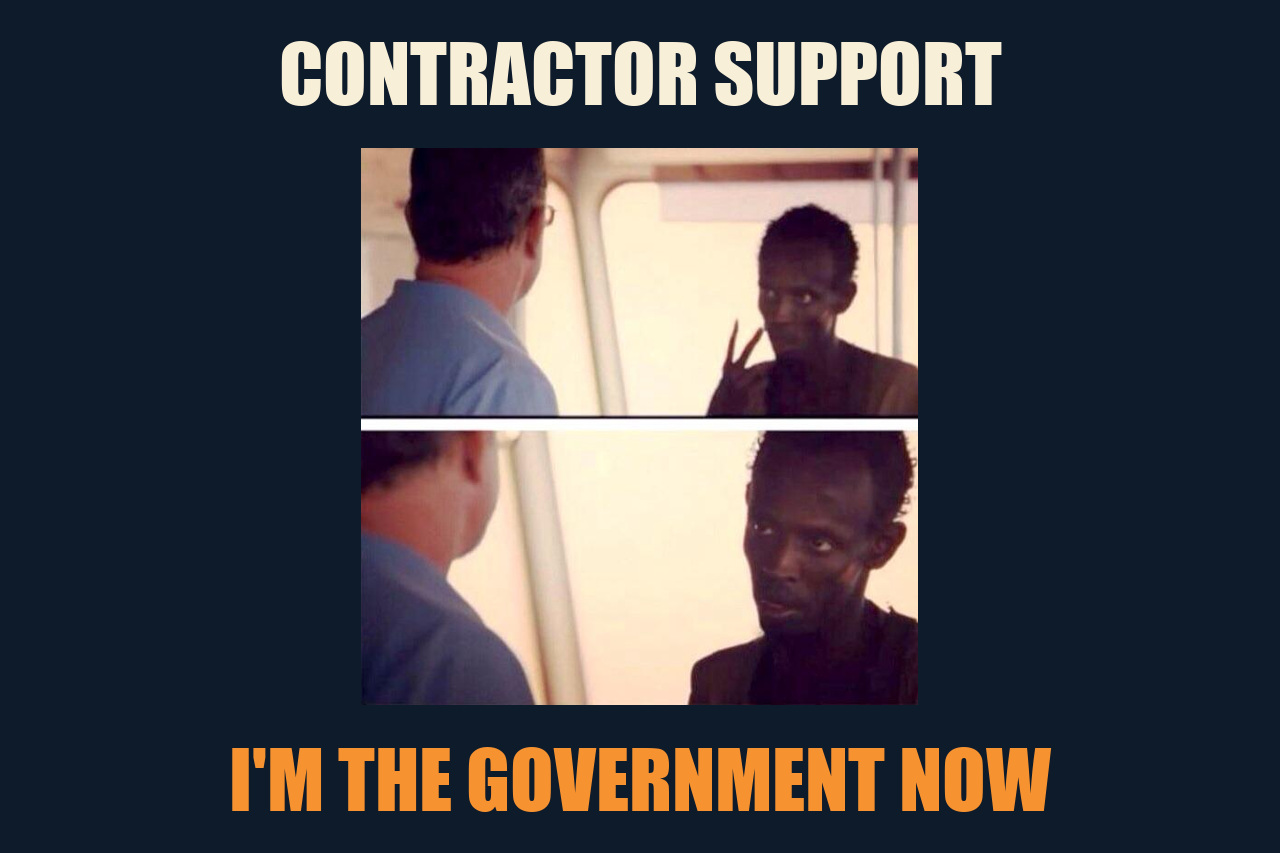
Contractor support became the government spending decision.

Inspectors identified at least 641 Fort Meade freight tenders issued through overrides or bypasses without government oversight or proper authority.

Look at Me, I'm the Captain Now meme: CONTRACTOR SUPPORT / I'M THE GOVERNMENT NOW
CONTRACTOR SUPPORT / I'M THE GOVERNMENT NOW

What happened

The September 28 management advisory, listed on Oversight.gov September 29, examined 2024 and 2025 records. Contractors at Fort Meade selected carriers and generated bills of lading, including bypasses of lower-priced carriers. Officials described no government review of tenders at or below $3,000 and only cursory review above that level.

The inspector general said those decisions could involve inherently governmental functions. Its wider concern included about 813 contractors with access to the freight systems, but it did not find that every one had acted improperly.

Why CMCoE cares

Issuing the bill of lading commits government funds. A contractor's support role cannot substitute for the authorized government decision.

Regulatory fine print

This is a retrospective on the report, not a claim that the same practice continues today. USTRANSCOM partially agreed: it said existing rules already prohibited contractors from obligating funds and called this a compliance problem. It nevertheless planned clearer language by November 1. Logistics leadership agreed to task a broader review. The report recorded both recommendations as resolved but open; the October 14 public-page check did not establish later closure. No quantified loss or proven fraud was reported. The film characters do not portray actual personnel.

Sources

  1. DoW OIG: management advisory DOWIG-2026-123, findings and management responses (Department of War Office of Inspector General, )
  2. Oversight.gov: report listing, checked October 14 (Oversight.gov, )
AbilityOne / Competition / New directive

Want competition? Wanting competition is not a qualifying reason.

AbilityOne's October 13 directive limits the grounds for competing existing Procurement List service requirements.

Woman Yelling at a Cat meme: WE WANT COMPETITION / YOUR REASON CANNOT BE COMPETITION
WE WANT COMPETITION / YOUR REASON CANNOT BE COMPETITION

What happened

Directive 27-02 says a general preference for competition is insufficient. Performance requests need at least two final adverse CPARS evaluations in five years; innovation requests must identify specific emerging commercial technologies or techniques.

Price alone cannot support a federal agency's direct competition request. A pricing competition may instead be directed by the Commission's subcommittee after a declared impasse and exhaustion of the pricing remedies.

Why CMCoE cares

The directive narrows the acceptable justification for changing which participating nonprofit performs an existing service requirement.

Regulatory fine print

Effective immediately, the directive applies to competitive distributions within AbilityOne, not to every federal procurement. The Commission says the limits make the process predictable and equitable while supporting employment opportunities and best value. Agencies cannot appeal an allocation merely because they disagree, but a defined Ombudsman referral remains available for clear policy or authority problems. The joke targets the rule's wording, not AbilityOne workers.

Sources

  1. AbilityOne: Directive 27-02, competitive distributions (U.S. AbilityOne Commission, )
AbilityOne / GSA / Country-of-origin records

The country-of-origin field had instructions for a country that does not exist.

AbilityOne says GSA previously told its central nonprofits to enter XX or ZZ, yielding N/A in the product portal.

Confused Travolta meme: COUNTRY OF ORIGIN: ZZ / PLEASE LOCATE ZZ ON THE MAP
COUNTRY OF ORIGIN: ZZ / PLEASE LOCATE ZZ ON THE MAP

What happened

The current October 9 version of Directive 27-01 orders central nonprofits to replace those placeholders with accurate country-of-origin information by November 6. It says GSA had not yet provided additional written instructions for those fields.

The directive also sets November 12 sourcing-compliance steps for AbilityOne products on GSA schedules and blanket purchase agreements, with waiver and waiver-request provisions. It follows GSA's August removal of the Trade Agreements Act exception for these vehicles.

Why CMCoE cares

Country-of-origin compliance depends on accurate catalog data. The Commission is replacing the placeholder practice while new GSA sourcing requirements take effect.

Regulatory fine print

This is the Commission's account of the prior GSA data-entry instructions. A placeholder does not establish where a product was made or prove false labeling. The November requirements include exceptions and dispute processes and do not apply identically to every distribution channel. The current directive is dated October 9, superseding an earlier October 8 copy encountered during research; the publication uses the current version.

Sources

  1. AbilityOne: current Directive 27-01, October 9 version (U.S. AbilityOne Commission, )
  2. GSA: CD-2026-03, removal of the sourcing exception (GSA, )
Army / Counter-drone acquisition / Integration

Fifty-plus systems met four networks and one swivel-chair problem.

The Army's October 13 Flytrap account says the bottleneck moved from defeating drones to combining the data.

Roll Safe meme: FOUR COMMON OPERATING PICTURES / THE SWIVEL CHAIR IS THE INTEGRATION
FOUR COMMON OPERATING PICTURES / THE SWIVEL CHAIR IS THE INTEGRATION

What happened

During May 2026 trials, troops used more than fifty counter-drone, aerial and ground systems over ninety hours of maneuvers. Commanders struggled to combine feeds across four separate battle-management networks.

The Army describes a multi-COP swivel-chair problem and plans a unified-network command-post exercise beginning in fall 2026. Further unmanned ground vehicles and electronic-warfare equipment are planned through prize-challenge contracting mechanisms for the next phase.

Why CMCoE cares

Buying useful individual systems does not automatically produce a usable common picture. The next acquisition phase must address integration as well as hardware.

Regulatory fine print

The source is an October 13 account of earlier trials and future plans, not an October contract award. The May trials, fall exercise and winter/spring 2027 milestones are distinct dates. Army leadership says the rapid approach puts workable equipment into soldiers' hands and builds proficiency; the article does not verify that the unified interface has already been delivered.

Sources

  1. U.S. Army: Restructuring Tactical Drone Defense for the European Frontline (U.S. Army, )
GSA / Small business / Market access

The startup springboard now comes with a federal-sponsor prerequisite.

GSA's October 13 guidance ties Startup Springboard to FASt Lane eligibility and an agency sponsor.

Condescending Wonka meme: STARTUP SPRINGBOARD / FIRST, BRING YOUR OWN FEDERAL SPONSOR
STARTUP SPRINGBOARD / FIRST, BRING YOUR OWN FEDERAL SPONSOR

What happened

GSA says Refresh 33, issued in October, makes Startup Springboard available across all large categories exclusively for FASt Lane offers sponsored by a federal agency. The program permits alternative evidence for companies or offerings with less than two years of experience.

FASt Lane's requirements call for a signed agency request explaining a compelling need and the vendor's importance to it. A general desire for more competition normally is not enough.

Why CMCoE cares

Reduced experience barriers still leave an access gate: an eligible new supplier needs a federal customer willing to support expedited processing.

Regulatory fine print

The page was updated October 13; it dates Refresh 33 to October without specifying an effective day. This is eligibility for an accelerated offer process, not a contract award, guaranteed sales or evidence of favoritism. Financial responsibility, normal contract terms and minimum sales requirements remain. GSA presents the programs as ways to meet urgent agency needs and speed access to qualified supplies and services.

Sources

  1. GSA: Startup Springboard, updated October 13 (GSA, )
  2. GSA: FASt Lane requirements, updated October 6 (GSA, )